
The Rise of the Backhand Flick in Women's Doubles Pickleball
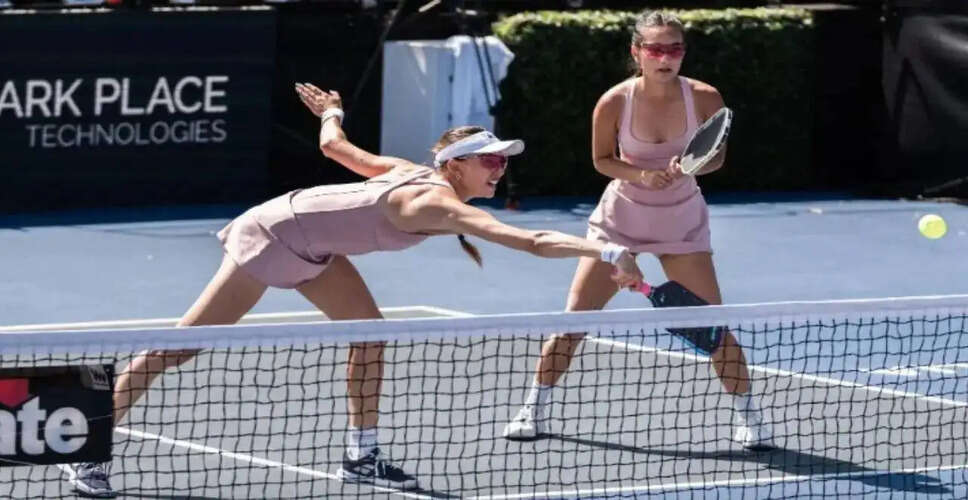

Transforming Women's Doubles Pickleball
The landscape of women's doubles pickleball is evolving, particularly at the kitchen line. A technique once predominantly seen in men's play—the sharp backhand flick—is now making its mark in the women's circuit, altering the dynamics of tempo, strategy, and anticipation in competitive matches.
This backhand flick is fundamentally about gaining an edge by reducing reaction time. It disrupts opponents' rhythm and compels them to make quick decisions. For players like Alix Truong, this shot is not merely a technical skill but a strategic asset in a rapidly changing game.
“The backhand flick is gaining traction in the women’s game because it limits the time available to opponents,” Truong explained, emphasizing her focus on refining this shot for women's doubles. “While stepping back to hit the ball is effective, being able to reach and strike early provides a significant advantage.”
Early Adopters of the Flick
Truong is part of a new generation embracing this technique, while Mari Humberg was among the first to incorporate it into her professional play. Interestingly, Humberg discovered the flick instinctively. “When I began playing pickleball, I naturally executed a backhand flick without realizing it,” she shared. “It stemmed from my tennis background, and I learned by observing local players.”
Over time, this instinctive move has become a hallmark of Humberg's style, influencing other top players like Anna Leigh Waters and Anna Bright to adopt the flick into their gameplay.
However, mastering this shot is no simple feat. It requires precision, timing, and quick recovery. Truong notes that the real challenge lies not only in executing the flick but also in the subsequent movements. “Anyone can learn to flick, but the key is developing effective combinations. If you extend your arm to flick, you must be able to recover quickly and maintain compactness,” she elaborated.
Adapting the Technique
Truong's learning has also been influenced by insights from the men's game. Having observed how male players embraced the flick earlier, she sought advice from her brother, Jonathan, highlighting the cross-gender exchange of tactical ideas in pickleball. “For some female players, the flick motion feels awkward, leading to a more poking action instead. However, as long as the ball is played quickly and accurately, it serves as a viable alternative,” she noted.
This adaptability between flicking and poking has become essential during matches. Players must quickly assess which shots to execute based on the ball's trajectory and their positioning. “It’s about reading the ball early and determining which shots to flick or poke to unsettle opponents,” Truong explained.
Interestingly, her experimentation with the flick was influenced by her experiences in Vietnam, where the slower pace allowed her to refine her technique. “I started practicing the flick in Vietnam because the ball moved slower, giving me the opportunity to master it. In the US, the Life Time ball is much faster, making adjustments more challenging,” she added.
Currently, Truong's backhand flick is still a work in progress, being fine-tuned in practice sessions before its debut in professional matches. When it finally makes an appearance, it will not only showcase a new skill but also represent the evolution of the women's game as it adapts and redefines its tactical approach.