
Revolutionizing Table Tennis: The Impact of TTR Technology in UTT

Introduction of TTR in UTT
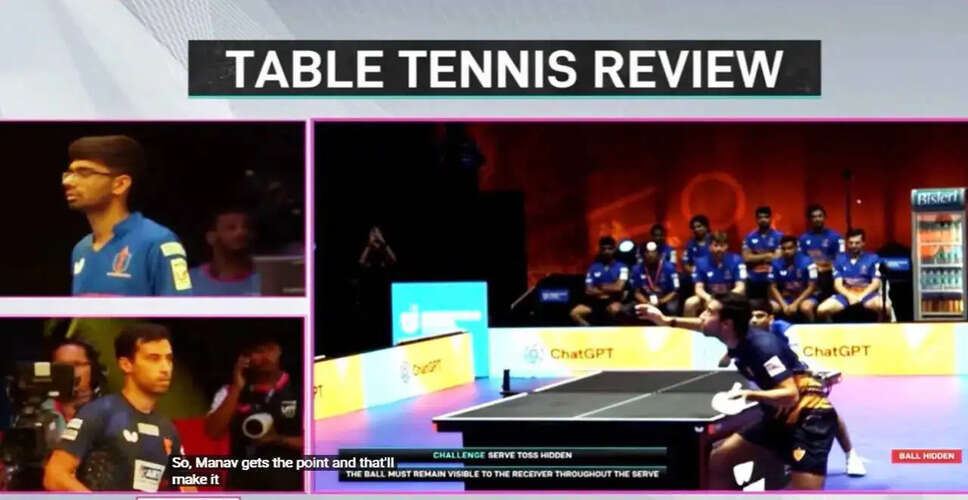
Recently, during a match featuring Dempo Goa Challengers, Álvaro Robles executed a left-handed forehand that prompted Dabang Delhi TTC's G. Sathiyan to request a Table Tennis Review (TTR). This innovative video-assisted technology, now utilized in the Ultimate Table Tennis (UTT) 2026, allows for precise evaluations of plays. Umpire Vipin Mehra, equipped with a Blue Badge, reviewed the rally from various angles, confirming that Robles' shot had grazed the table's edge—an aspect that would have been nearly impossible to see without the technology. The decision favored Dabang Delhi, showcasing how TTR enhances accuracy and transparency in the sport while easing the umpires' responsibilities.
TTR's Role in Player Development
Similar to the Video Assistant Referee (VAR) in football, TTR made its first live appearance at the ITTF World Tour Grand Finals in 2019 and has since been adopted in significant tournaments, including the ITTF Mixed Team World Cup 2024 and the ITTF World Cup 2025. As TTR debuts in the seventh season of UTT, it is anticipated to significantly influence player education regarding the system's application. Jay Modak, coach of U Mumba TT, emphasized that TTR is instrumental in helping grassroots players refine their service techniques and understand the game's intricacies.
Understanding the TTR Process
Modak elaborated on the three critical aspects monitored by TTR: the height of the toss, the angle of the serve, and whether the ball is concealed during the serve. An instance arose when UP Prometheans' Manav Thakkar challenged a serve from Dabang Delhi's Youssef Abdelaziz, claiming it was too high. The chair umpire accepted the challenge, and TTR confirmed that the serve was indeed too high.
Enhancing Techniques Through TTR
Focus on Technique Improvement
TTR has encouraged players and coaches to refine their techniques, leading to noticeable improvements in their serves and overall gameplay. Within just a week of the seventh UTT season, players have become more technically astute, demonstrating increased caution in their shot execution. Modak noted a significant transformation, particularly praising players like Snehit Suravajjula, Diya Chitale, and Sayali Wani, who have adapted their techniques to comply with the review system.
Long-Term Effects of TTR
Future Prospects for TTR
Currently, TTR employs 14 cameras to assess various challenges, including serve height and angle, compared to the 10 cameras used in World Table Tennis (WTT) events. Modak suggested that for TTR to achieve complete reliability, enhancements are necessary, such as adding a camera to monitor the service bounce, which could eliminate potential controversies in the future.