
Manika Batra Raises Concerns Over Asian Games 2026 Selection
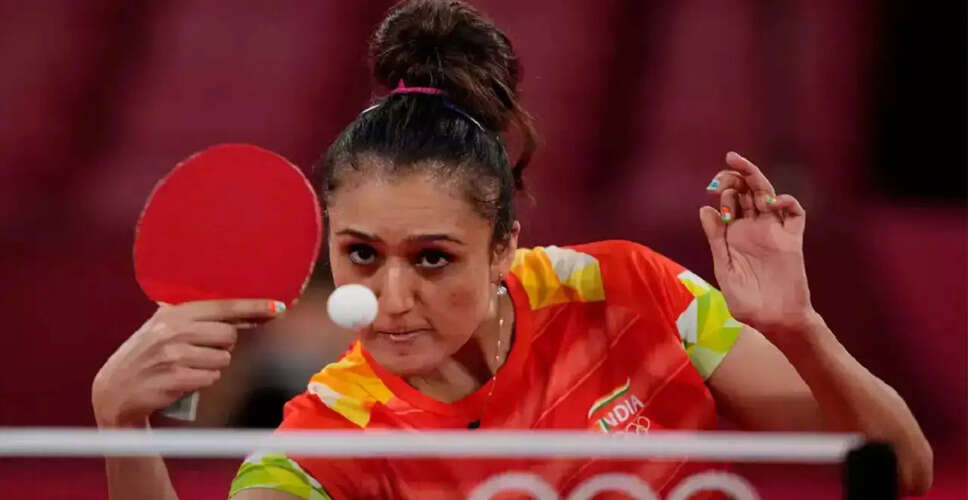

Manika Batra's Exclusion Sparks Controversy
Indian table tennis star Manika Batra has expressed her disappointment regarding her omission from the national team for the upcoming 2026 Asian Games, scheduled from September 19 to October 4 in Aichi-Nagoya, Japan. The Table Tennis Federation of India (TTFI) announced a squad comprising ten players, evenly split between men and women. Despite being one of India's most accomplished players, her exclusion has become a major topic of discussion. Manika made history by securing India's first medal in table tennis at the Asian Games in 2018, winning a mixed doubles bronze with Sharath Kamal. Additionally, she has earned two gold medals and one silver and bronze at the Commonwealth Games. The TTFI's selection was based on a mix of international and domestic rankings, with automatic qualification for players ranked in the top 50 globally. Unfortunately, Manika fell just short, being ranked 51st, although she was the second-highest ranked Indian player behind Sreeja Akula.
In her statement, Manika criticized the selection process, calling for greater transparency. She questioned whether a single ranking position should determine her exclusion and defended her national ranking, arguing that maintaining consistency across both international and domestic competitions is challenging.
Manika Batra's Statement
For nearly two decades, I have devoted my life to representing India. Every medal and achievement has been earned while donning the Indian jersey. I have never sought special treatment, only that the same standards be applied uniformly to all athletes. My exclusion from the Asian Games 2026 team is disheartening, not just because of the outcome but due to the perceived inconsistency in the selection criteria. I have not received any specific reasons for my exclusion. I respectfully urge the Sports Minister and the Indian Olympic Association to investigate this matter to ensure a transparent and fair selection process for all athletes.
It is crucial that the selection framework, which reportedly combines World Ranking, National Ranking, and Selection Committee discretion, is clearly communicated to the athletes involved. I have observed that during the last Asian Games selection, players outside the typical ranking thresholds were still included under special considerations. This raises questions about how similar principles were applied in my case.
Currently, I am ranked World No. 51, having recently slipped just outside the top 50. The margin is very slim, and I remain close to that ranking bracket. I find it difficult to understand how this slight difference could outweigh my long-standing performance at the highest levels. Furthermore, international ranking points are based on a rolling system, meaning older points are replaced, which can distort the current picture of an athlete's form. If rankings are a primary selection criterion, the timeline and sustainability of ranking changes should also be taken into account.
This season, I have shown consistent performance, defeating strong international competitors, including U-19 champions from China. My current form reflects my ability to compete at a high level internationally. If rankings are to be the main basis for selection, it is essential to acknowledge that fluctuations in rankings are common among athletes and can change rapidly.
Regarding National Ranking, I understand that domestic performance has been a factor in the selection discussions. However, with the increasing number of international tournaments, it is often not feasible to participate in every domestic event. My focus has consistently been on representing India internationally, and national rankings should be viewed in light of these commitments.
Throughout my career, I have achieved significant milestones, including a bronze medal in mixed doubles at the 2018 Asian Games and multiple Commonwealth Games medals. I also made history as the first Indian woman to reach the Olympic singles Round of 16 and the first Indian table tennis player to reach the singles quarterfinals at the Asian Games. These accomplishments should be considered in any selection process.
A major concern is the consistency in applying selection criteria. If discretion is involved, it must be applied transparently and uniformly. Any inconsistency raises questions about fairness. I have formally requested a detailed explanation for my non-selection, including the criteria used and how each factor was weighed in my case. This statement is not about personal grievances but about ensuring transparency and fairness in the selection process. Athletes dedicate their lives to their sport, and they deserve a clear and consistent selection process.
India's Table Tennis Team for the 2026 Asian Games
- Men: G Sathiyan, Harmeet Desai, Manav Thakkar, Manush Shah, Payas Jain
- Women: Sreeja Akula, Yashaswini Ghorpade, Diya Chitale, Sutirtha Mukherjee, Syndrela Das
- Reserves: Ankur Bhattacharjee, Ronit Bhanja (men); Swastika Ghosh, Manika Batra (women)