
Historic Space Mission: Indian Air Force Pilot Shubhanshu Shukla Joins Axiom 4
A Moment of Pride for India
On June 25, legendary cricketer Sachin Tendulkar expressed his pride in Indian Air Force Group Captain Shubhanshu Shukla, who has made history as only the second Indian to venture into space, following Rakesh Sharma's iconic journey 41 years ago.
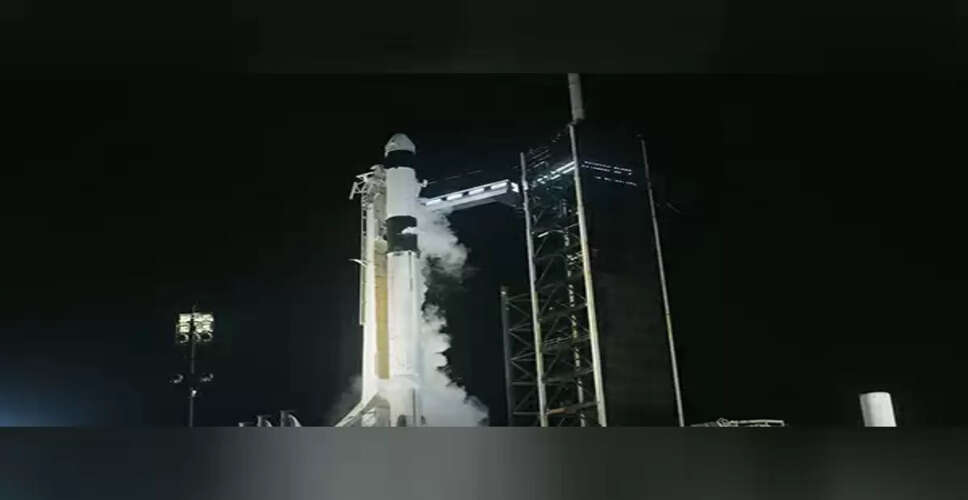
At 39 years old, Shukla is piloting the SpaceX Dragon spacecraft as part of the highly anticipated Axiom 4 mission, which aims to reach the International Space Station. The launch took place aboard SpaceX's Falcon 9 rocket from NASA's Kennedy Space Center in Florida.
Tendulkar shared his thoughts on social media, stating, "What a proud moment for India, the @IAF_MCC & @isro. We should ensure every child across every corner of India gets to see this video and witness Group Captain Shukla and the crew's journey. There's nothing more powerful than inspiration to spark the imagination of young minds. Jai Hind, Jai Bharat! #AxiomMission4."
हम सब इस सफर में आपके साथ हैं, ग्रुप कैप्टन शुभांशु शुक्ला|
What a proud moment for India, the @IAF_MCC & @isro.
We should ensure every child across every corner of India gets to see this video, and witness Group Captain Shukla and the crew’s journey.
There’s nothing more… pic.twitter.com/kVbWudqETT
— Sachin Tendulkar (@sachin_rt) June 25, 2025
The Axiom Mission 4 marks the fourth private astronaut mission to the International Space Station, with the crew traveling aboard a new SpaceX Dragon spacecraft. The expected docking time is around 7 AM Eastern Time (4 PM IST) on June 26.
Once they arrive, the astronauts plan to spend up to 14 days at the space station, engaging in a mission that includes scientific research, outreach, and commercial activities. Peggy Whitson, a former NASA astronaut and current director of human spaceflight at Axiom Space, leads the mission, while Group Captain Shubhanshu Shukla serves as the pilot. The team also includes European Space Agency astronaut Slawosz Uznanski-Wisniewski from Poland and Tibor Kapu from Hungary.
The astronauts will wear the new Axiom Extravehicular Mobility Unit (AxEMU) spacesuits, designed to enhance their capabilities for space exploration while providing NASA with essential human systems for lunar missions. These advanced suits ensure that astronauts are equipped with high-performance gear suitable for a diverse range of crew members.
The Ax-4 mission will conduct significant research, featuring around 60 scientific studies and activities from 31 countries, including the US, India, Poland, Hungary, Saudi Arabia, Brazil, Nigeria, UAE, and various European nations.
This mission will see the most extensive research and scientific activities undertaken on an Axiom Space mission to date. NASA and ISRO (Indian Space Research Organisation) are collaborating on several scientific investigations.
Research topics include muscle regeneration, the growth of edible microalgae and sprouts, the survival of tiny aquatic organisms, and human interaction with electronic displays in microgravity.
The first private astronaut mission, Axiom Mission 1, launched in April 2022 for a 17-day stay at the space station. Axiom Mission 2 followed in May 2023, also commanded by Whitson, with four private astronauts spending eight days in orbit. The latest mission, Axiom Mission 3, launched in January 2024, with the crew docked for 18 days.
The International Space Station serves as a hub for science, technology, and human innovation, facilitating research that cannot be conducted on Earth. For over 24 years, NASA has maintained a continuous human presence aboard the station, allowing astronauts to learn how to live and work in space for extended durations.