
Controversy Erupts Over England's Goal in FIFA World Cup Match Against Norway

Match Overview
The ongoing 2026 FIFA World Cup has sparked yet another debate during the group stage encounter between England and Norway. The match, held at the Hard Rock Stadium in Miami, ended with England triumphing 2-1 after extra time, setting the stage for a highly anticipated showdown against Argentina, led by Lionel Messi. Jude Bellingham emerged as the standout player, netting two goals, including one just after halftime and another in the 93rd minute, turning around a 1-0 deficit.
The Camera Cable Incident
The Camera Cable Incident
Controversy arose when replays indicated that Norway's goalkeeper, Orjan Nyland, had his goal kick inadvertently interfere with England's first goal. The ball appeared to strike the camera cables suspended above the field, causing it to bounce awkwardly to Antony Gordon, who then assisted Bellingham. According to the rules, the play should have been halted due to the interference from the cables, yet the Video Assistant Referee (VAR) chose not to intervene during this critical moment.
FIFA's Response
FIFA's Response
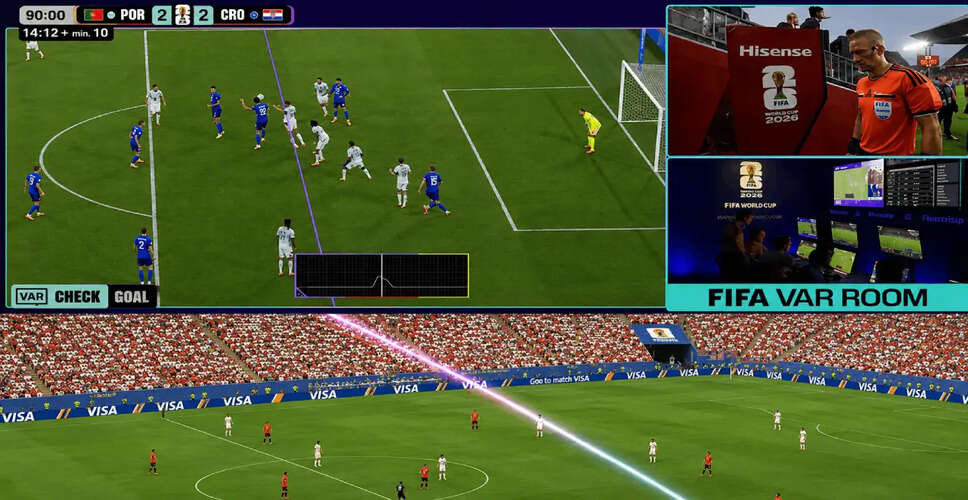
In light of the backlash, FIFA released a statement asserting that their connected ball technology did not register any contact with the camera cables. They explained, "Before England’s goal in minute 45+2 against Norway, the sensor in the Connected Ball showed no peak in the 'heartbeat of the ball' when in the air, indicating no evidence of contact with the overhead wire that could have altered its trajectory."
Understanding Connected Ball Technology
Understanding Connected Ball Technology
This technology, akin to the snickometer in cricket, features a chip embedded within the ball that detects contact. FIFA describes it as an innovative system developed in partnership with Adidas, designed to provide real-time data on the ball's movement and position. This technology aims to enhance decision-making for VARs by offering detailed insights into ball dynamics, including contact moments and trajectory, thereby improving accuracy and fairness in football.
Ongoing Questions for FIFA
Ongoing Questions for FIFA
Despite FIFA's explanation, skepticism remains regarding the reliability of the connected ball technology. Video replays seem to indicate that the ball did indeed touch the wire, with various angles showing a noticeable deflection. Even a 3D replay from a media outlet highlighted an irregularity in the ball's path before it landed.
Previous Controversies
Previous Controversies
This incident has reignited discussions about the technology's reliability, particularly recalling a previous match between Portugal and Croatia where the same technology flagged a goal due to a player's hair brushing the ball. This inconsistency raises concerns about whether the technology was applied correctly in both instances, potentially impacting match outcomes.