
Engineering Students Innovate to Reduce Pickleball Noise

Addressing Noise Concerns in Pickleball
The surge in popularity of pickleball across the United States has led to significant changes in parks, clubs, and suburban areas. However, the sport's distinctive 'pop' sound has sparked complaints from residents living near active courts. In response, a team of engineering students from Worcester Polytechnic Institute (WPI) has embarked on a project aimed at addressing one of the sport's major off-court issues: noise.
These students have recently concluded a study to determine if a quieter version of the pickleball could be created without compromising competitive integrity. This initiative comes at a time when noise complaints related to pickleball are on the rise in various American neighborhoods, where residents have voiced concerns about the disruptive sounds generated during games. One student noted, “The loud pop from the paddle can become problematic in residential areas.”
Research indicated that a typical quiet evening in a suburban setting registers around 40 decibels, while pickleball matches can often reach 70 decibels, with some spikes hitting 90 decibels. The WPI team concentrated on two main strategies to lower the noise: altering the ball's shape and testing various materials.
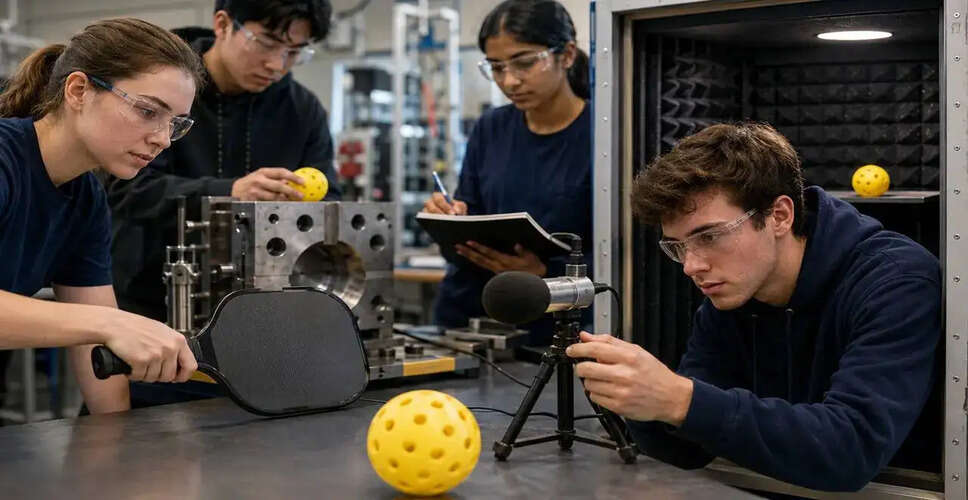
“Our aim was to create a quieter outdoor pickleball that still adhered to competition standards,” the students shared during their project presentation. To facilitate their research, they constructed a specialized acoustic chamber to measure sound levels between standard pickleballs and their modified versions. They also designed custom molds for injectable polymers, testing factors like ball density, bounce consistency, and impact response to ensure the quieter balls maintained the necessary playing characteristics.
Despite facing technical hurdles, the team successfully achieved notable reductions in sound levels through various design changes. Associate Professor Fiona Sodenike, who supervised the project, described their efforts as ambitious yet promising. “They’ve developed this equipment and built a lab-scale injection molder, which could be adapted for future projects,” Sodenike remarked. “There are numerous potential directions for other teams to explore.”
The students collaborated with the university’s pickleball club to evaluate different prototypes and gather player feedback regarding feel, bounce, and overall performance. As pickleball continues to grow rapidly in residential areas across North America and Europe, noise has emerged as a contentious issue. Many municipalities in the U.S. have encountered legal challenges, court restrictions, and community pushback due to noise complaints. As global participation in pickleball rises, initiatives like WPI’s quieter ball project may play a crucial role in reconciling the sport's expansion with community concerns.