
The Legendary Sharjah Six: A Moment That Defined Cricketing Rivalry

The Iconic Moment in Cricket History
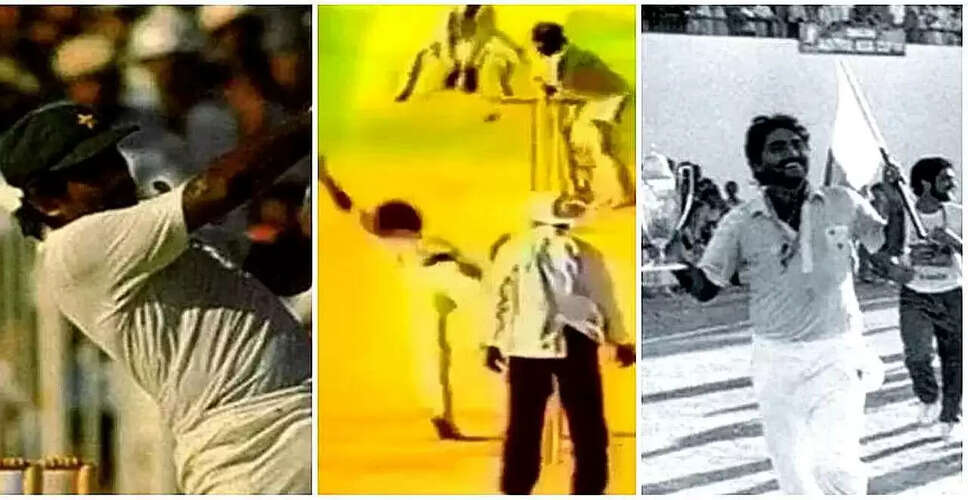
In 1986, Javed Miandad's unforgettable six off Chetan Sharma on the last ball not only created a thrilling finish but also etched Sharjah into cricket history. This venue became synonymous with the fierce rivalry between India and Pakistan, attracting enthusiastic crowds and even Bollywood stars, alongside notorious figures like gangster Dawood Ibrahim.
Chasing a target of 246 runs, Miandad entered the game at a precarious 61/3 and went on to score a remarkable 116 not out from 114 deliveries. With four runs needed from the final ball, Sharma bowled a low full toss, which Miandad expertly dispatched over mid-wicket, igniting celebrations among Pakistani fans. Legend has it that Miandad was later awarded a golden sword for his remarkable performance.
Even after four decades, this moment remains a focal point in the narrative of India-Pakistan cricket. For Sharma, it was a pivotal moment in his career. He reflected, “At 18 or 19, being trusted with the last over was a big deal, but my mind went blank.”
India had opportunities to clinch the match earlier, but they slipped away. Sharma noted, “Throughout that over, there were ups and downs. I took two wickets, but we missed a run-out and another chance. We had our opportunities, but Miandad capitalized on his.”
Sharma was clear about his intentions on that final delivery. “I aimed for a yorker, but it turned into a low full toss. Miandad capitalized on it. He was undoubtedly one of the best batsmen of that time.” Despite the immense pressure, Sharma viewed the situation differently, stating, “Back then, defending 10 to 12 runs was manageable.”
What followed was a period of solitude for Sharma, which he describes as a necessary phase. “For about 15 to 20 days, my coach isolated me. I practiced alone daily, with him supervising. No one was allowed to talk to me,” he recalled. This rigorous training paid off, as he later excelled in England, taking 16 wickets in two Test matches, marking India’s first victory in 21 years.
Despite the lasting memory of that six, Sharma does not view it as a burden. “As a cricketer, you learn from your experiences, whether good or bad. It’s all part of the game.” He emphasized that one moment does not define a career, stating, “I played most of my career after that. Ups and downs keep you grounded and motivate you to improve.”
In the aftermath of the match, Sharma received immediate support from his teammates. “Everyone was there for me, reassuring me that it was okay. Losing to Pakistan is always significant.” Over the years, he has shared the stage with Miandad, who has his own take on that fateful ball. “He often says it was just one bad delivery. Otherwise, I bowled well that day,” Sharma shared.
Four decades later, the Sharjah six transcends mere statistics. It represents a pivotal moment that influenced careers, rivalries, and memories across generations. For Chetan Sharma, it’s about resilience and the journey that followed. For fans, it remains a classic tale of cricketing drama, reminding us that sometimes, recovery is more significant than the fall itself.