
South Africa Faces Daunting Chase Against Australia in ICC World Test Championship
A Challenging Target Awaits South Africa
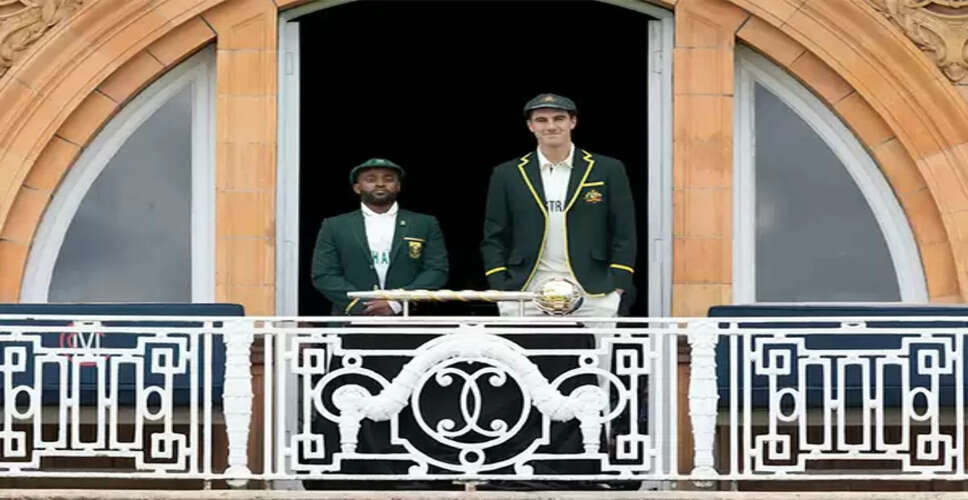
In London, South Africa is tasked with a formidable challenge as they aim to chase down 282 runs to secure victory against Australia and claim the ICC World Test Championship trophy. This would mark their first significant world title in cricket. Despite having over two and a half days of play remaining, a closer look at the statistics reveals that the Proteas will need to perform exceptionally well to achieve this target.
A notable moment in the match was a frustrating partnership between Mitchell Starc and Josh Hazlewood, who added 59 runs for the 10th wicket. Starc's achievement of scoring the first fifty by a number nine or lower in an ICC knockout match helped Australia recover from 152/9 to a total of 207, setting a challenging target of 282 for South Africa.
Historically, only two successful run chases of 280 runs or more have occurred at Lord's: the West Indies' 342 runs against England in 1984, winning by nine wickets, and England's 282 runs against New Zealand in 2004, winning by seven wickets. The West Indies' victory was led by Gordon Greenidge's remarkable 214*, while England's win featured Nasser Hussain's 103* in his final Test, alongside significant contributions from Andrew Strauss.
South Africa has only managed to chase down targets exceeding 250 runs in Test cricket five times, with three of those instances against Australia. Their last successful chase of this magnitude occurred in 2008 at WACA Stadium in Perth, where Graeme Smith and AB de Villiers both scored centuries to achieve a daunting 414-run target.
In the current match, after South Africa opted to bowl first, Australia found themselves struggling at 67/4 by the end of the first session. A partnership of 79 runs between Steve Smith (66 runs off 112 balls) and Beau Webster (72 runs off 92 balls) helped stabilize the innings, along with Webster's collaboration with Alex Carey (23 runs off 31 balls).
However, Kagiso Rabada (5/51) and Marco Jansen (3/49) maintained pressure, restricting Australia to 212 runs. South Africa's batting woes continued as they lost four wickets for just 43 runs by the end of the first day, with none of their batsmen scoring over 20 runs.
On the second day, South Africa showed improved intent with the bat, as captain Temba Bavuma (36 runs off 84 balls) and David Bedingham (45 runs off 111 balls) formed a half-century partnership. Unfortunately, Pat Cummins (6/28) delivered a historic bowling performance, leading to another collapse as South Africa was bowled out for just 138 runs, trailing by 74 runs.
During Australia's second innings, South Africa's bowlers shone again, reducing Australia to 73/7. However, Alex Carey (43 runs off 50 balls) and Starc managed to add 61 runs together, ending day two at 144/8.
On the third day, South Africa dismissed Nathan Lyon early, but Starc and Hazlewood (17 runs off 53 balls) frustrated the Proteas with a 59-run partnership. Australia was eventually all out for 207, leaving South Africa with a target of 282 runs to win the ICC WTC trophy.
Rabada (4/59) and Lungi Ngidi (3/38) were the standout bowlers for South Africa, with Wiaan Mulder, Marco Jansen, and Aiden Markram each taking a wicket.