
Rishabh Pant's Brave Comeback Shines Amidst England's Dominance
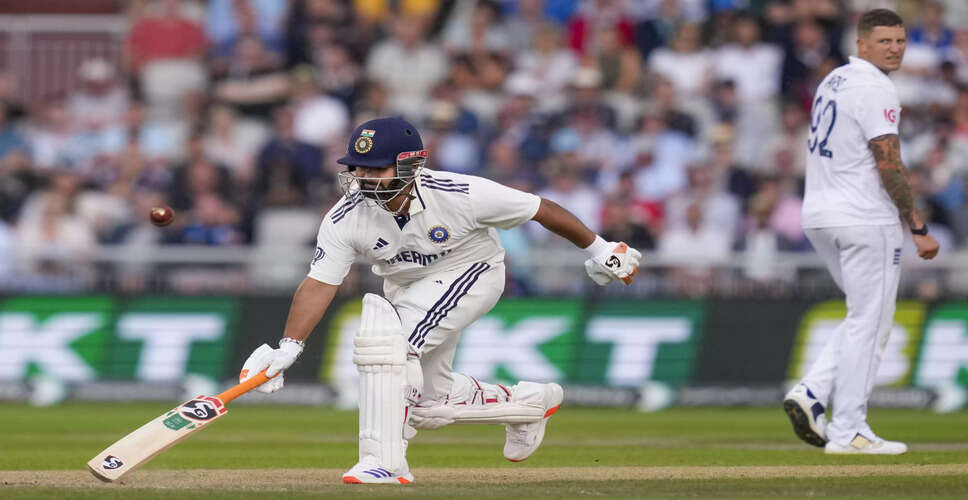
Rishabh Pant's Remarkable Resilience
What emotions must Rishabh Pant be experiencing? His foot is likely in agony—fractured, swollen, and numbed by painkillers. Yet, beyond the physical pain, adrenaline must still be surging through him. He returned to bat when it wasn't necessary, scoring a half-century when many would have opted to rest, showcasing not just runs for India but a spirit of defiance.
His counterattacking 54, crafted with determination and skill, illuminated the dreary Thursday morning at Old Trafford. He hit Archer for six and elegantly drove Stokes through the covers. Despite limping between the wickets, he stood firm at the crease. His comeback was not merely brave; it was a statement. For a fleeting moment, the game felt like it was his.
For Indian supporters, this was more than just a brief appearance. Pant has carved out a unique place in the hearts of fans as the fearless warrior who can turn matches with his instinctive play. He became a legend in 2021 at the Gabba, clinching a historic victory over Australia with a daring 89 not out. Following that, a car accident in 2022 nearly cost him his life, leading to months of silence and a challenging recovery. On Thursday, as he limped through Old Trafford and continued to hit boundaries, he transformed from a cricketer into a symbol of recovery, resilience, and rebellion.
India's innings, built around that moment of defiance, concluded at 358. England then took to the field. By the end of Day Two, their openers had nearly erased the deficit with a century partnership that felt almost inevitable. It was not just about the runs but also the rhythm—the sense of ease and ownership. Duckett played with flair, while Crawley exhibited poise. Together, they resembled players who had been in this situation before.
Old Trafford itself holds memories. Like Lord’s, it is more than just a cricket ground; it is a testament to English cricket, where history intertwines with the present. Although the stands may be modern and the cameras sharper, the pitch still carries the whispers of tradition: this is home ground.
For visiting teams, the atmosphere rarely feels neutral. The light changes, the ball behaves differently, and the narrative shifts. Indian bowlers are well aware of this. Bumrah bowled with intensity, while Thakur sought angles. However, their lines faltered, lengths varied, and the ball lost its hardness. The result was a century opening stand—expected, yet scripted.
Pant's innings had briefly altered that narrative. When he left the field, heavily bandaged, it felt as if he was stepping into history with the intent to rewrite it. His half-century was not just a statistic; it invigorated India's lower order, prolonged their innings, and reminded both the opposition and his teammates that character is crucial.
The timing of his performance was particularly striking. Less than a day earlier, he had been carried off the field with a suspected fracture. Yet on Thursday, he wielded the bat like a beacon, illuminating the gloom.
However, by the afternoon, the momentum had shifted to England. Their dominance was familiar—confident, not boastful, just assured. They batted as if they belonged there. Perhaps this is the true legacy of empire: not just wealth or power, but a sense of comfort. The quiet confidence that this field is theirs.
Despite decades of triumphs and being the world's richest cricketing nation, India still approaches overseas matches with a hint of uncertainty. Every drop, every overthrow, every review carries added significance. Pant's innings provided a temporary lift from that pressure. But as Duckett unleashed his cuts and Crawley surpassed fifty, the atmosphere changed once more.
A new day brings fresh opportunities, new strategies, and possibly new heroes. Yet as Day Two concluded, the skies over Manchester were clear, and the scoreboard was unforgiving. England once again stood strong on home soil, and the old narrative lines had returned.