
India Faces New Zealand in Crucial Third ODI at Holkar Stadium
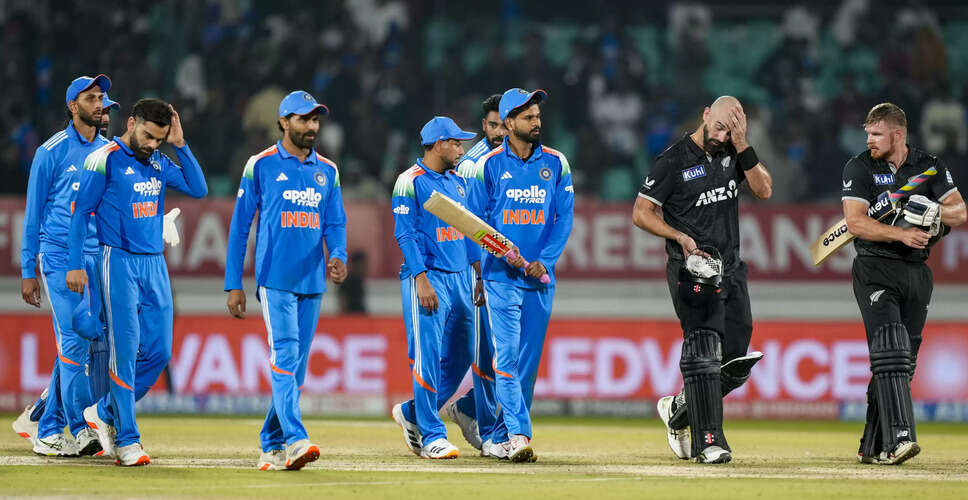
India's Home Dominance Tested Against New Zealand
India's impressive home record will be put to the test as they prepare to face a motivated New Zealand in the final ODI of their three-match series at the Holkar Stadium on Sunday, with the series currently tied at 1-1.
Since March 2019, India has not lost a bilateral ODI series on home soil, a streak that includes a remarkable comeback by Australia from a 0-2 deficit to win 3-2, including the decisive match in Delhi. However, this record is now at risk.
For New Zealand, the stakes are equally high. Despite touring India for ODIs since 1989, they have yet to secure a series victory on Indian soil, making this their best chance to change that narrative.
India's head coach, Gautam Gambhir, is keen to avoid further setbacks at home after experiencing several unwanted firsts, including five Test losses and an ODI series defeat in Sri Lanka during his tenure.
The second ODI loss in Rajkot was less about a single outstanding performance and more about how New Zealand dominated the middle overs.
Daryl Mitchell's unbeaten century showcased calculated aggression, particularly against spin, an area where India has struggled recently.
Indore's short boundaries and minimal assistance for bowlers leave little room for error.
India's struggles against spin have raised concerns. Despite having a powerful lineup, the team has shown discomfort in the middle overs, leading to stalled strike rotation and forcing batters into risky shots instead of steady accumulation.
In a venue where scores can quickly exceed 350, those quiet overs can significantly shift the momentum.
Focus on Rohit Sharma and Team Selection
Rohit Sharma will be under the spotlight as he navigates a challenging series. His aggressive batting style has been a hallmark of India's ODI strategy, but early dismissals have increased the pressure on him.
Virat Kohli continues to be the cornerstone of India's batting lineup. With the next major ODI series for senior players scheduled for July in England, fans are eager to see another stellar performance from him.
The decision between Nitish Kumar Reddy and Ayush Badoni presents a choice between depth and control. Reddy provides seam-bowling options and late-innings power, while Badoni offers a more disciplined approach against spin.
The argument for including left-arm pacer Arshdeep Singh strengthens in Indore, where variations often lead to success over sheer pace.
Arshdeep's ability to swing the new ball and execute yorkers effectively could provide India with a tactical advantage, especially against New Zealand's predominantly right-handed batting order.
His inclusion would also alleviate some pressure on the spinners during the middle and late overs, allowing for a more pace-oriented strategy, which is better suited to the conditions at Holkar Stadium.
The challenge lies in determining who he would replace, as Mohammed Siraj's role as a new-ball bowler makes him hard to exclude. The most likely candidate for replacement would be a spinner or a seam-bowling all-rounder, depending on the pitch conditions.
KL Rahul's position is already clear, as his performance at number five highlights the importance of keeping him there rather than moving him down the order, where his ability to manage the game's tempo would be compromised.
New Zealand's Confidence and Strategy
New Zealand enters the match with confidence and clarity. Mitchell's strong performance, supported by Devon Conway, reflects the Black Caps' ability to identify favorable match-ups and execute their game plan effectively.
Although their bowlers may not be household names, they have effectively utilized variations and hard lengths in conditions that offer little assistance.
At a venue where bowlers often find themselves in damage control mode, the outcome of the match will likely depend as much on decision-making as on skill.
For Shubman Gill and his team, the challenge extends beyond merely winning the series; they must also demonstrate tactical adaptability and situational awareness—qualities that are essential for success in tight matches.
Teams for the Match
India: Shubman Gill ©, Yashasvi Jaiswal, Virat Kohli, Rohit Sharma, KL Rahul (wk), Dhruv Jurel (wk), Ravindra Jadeja, Nitish Kumar Reddy, Ayush Badoni, Kuldeep Yadav, Arshdeep Singh, Prasidh Krishna, Mohammed Siraj, Harshit Rana.
New Zealand: Michael Bracewell ©, Devon Conway (wk), Mitchell Hay (wk), Nick Kelly, Henry Nicholls, Will Young, Josh Clarkson, Zak Foulkes, Daryl Mitchell, Glenn Phillips, Adithya Ashok, Kristian Clarke, Kyle Jamieson, Jayden Lennox, Michael Rae.
The match is set to commence at 1:30 PM.