
FIDE World Cup 2025 Semifinals Head to Tiebreaks After Draws
Semifinals Conclude with Draws
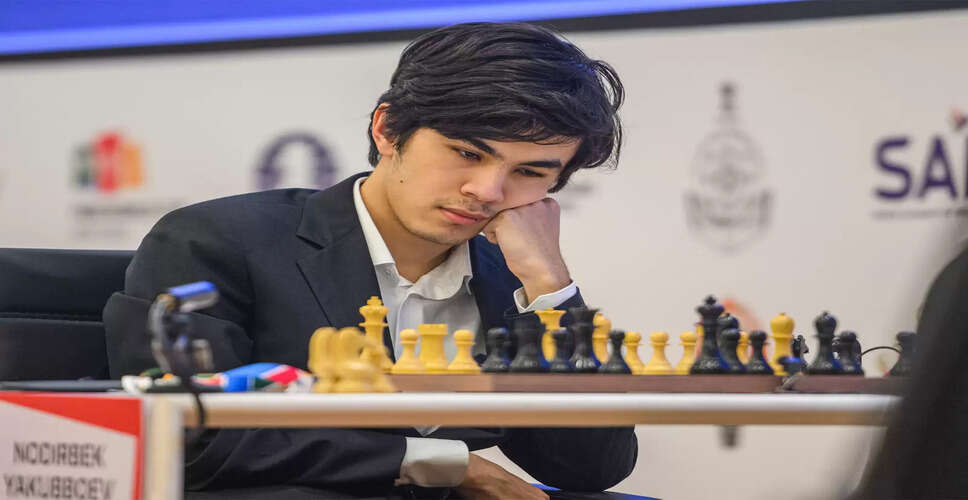
Panaji (Goa) [India], November 22: The semifinals of the FIDE World Cup 2025 are set for tiebreaks after Grandmasters Nodirbek Yakubboev and Javokhir Sindarov ended their match in yet another draw. Meanwhile, GM Andrey Esipenko was unable to penetrate the defenses of Chinese GM Wei Yi, as reported by FIDE.
In their first encounter, Wei Yi faced time pressure against Esipenko, this time playing with the black pieces. Known for his composure under stress, the Chinese player managed to navigate through the challenges with precise moves to reach the time control.
With little at stake regarding the outcome, Esipenko proposed a draw shortly after. Although Wei initially hesitated and attempted to advance with his queen, it became evident that a different result was unlikely, leading him to accept the draw after 37 moves.
In the other semifinal, the second game between Yakubboev and Sindarov mirrored the first, as both players opted for solid and cautious strategies until they reached the mandatory 30-move mark before agreeing to a draw.
Earlier, Union Minister of State for Skill Development and Education, Jayant Chaudhary, attended the FIDE World Cup 2025 and made a ceremonial move during the quarterfinal tiebreak. He emphasized the government's commitment to integrating sports into the academic curriculum under the new education policy, rather than relegating it to extracurricular status.
FIDE has declared 2026 as the Year of Chess in Education, and Chaudhary pledged his ministry's full support for any initiatives that the All India Chess Federation (AICF) and FIDE plan to implement in India.
Recently, FIDE and AICF formalized a partnership with KIIT University to enhance the role of chess in society and education. As part of this collaboration, an International Conference on Social Chess and Educational Chess is scheduled for January 2026 in Bhubaneswar, hosted by KIIT University, as part of FIDE's global initiative to investigate how chess can promote social inclusion and educational innovation.