
England Secures Historic Victory in Boxing Day Test Against Australia
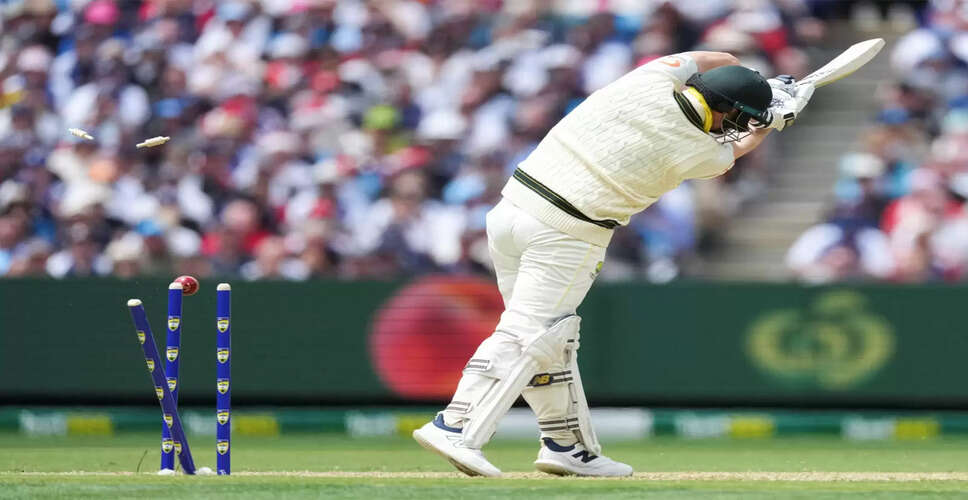
England Triumphs in Melbourne Test
In a thrilling turn of events, England marked their return to the Ashes series with a remarkable four-wicket win over Australia during the Boxing Day Test held at the Melbourne Cricket Ground. This match was significant not only for the outcome but also for several unique statistical achievements. Despite this loss, Australia maintains the Ashes with a 3-1 series lead.
The Melbourne Test is particularly noteworthy for achieving one of the highest match aggregates in Test cricket history without a single player reaching a half-century. The total of 572 runs places it among a select group of historic matches where batsmen struggled to convert their starts into substantial scores. The record for the highest aggregate without a half-century remains at 787 runs from the 1981 Edgbaston Test between Australia and England, followed by 652 runs in the 2015 Test between India and South Africa at Nagpur. The MCG Test now ranks third on this list.
Concluding in just two days, this Boxing Day Test is now the second shortest Ashes Test in Australia based on the number of balls bowled. The only shorter match was the Perth Test in 2025, which wrapped up in 847 balls. The Melbourne Test concluded after 852 balls, making it the fourth shortest completed Ashes Test overall.
Historically, only a few Ashes Tests have finished within two days. Notable instances include three matches in England in 1888 at Lord's, The Oval, and Manchester, along with another at The Oval in 1890. The Nottingham Test in 1921 also ended quickly, excluding a rest day. In recent times, only two Tests have joined this exclusive list: Perth 2025 and now Melbourne 2025.
While England's victory at the MCG provided a rare highlight in an otherwise challenging series, Australia still holds a commanding position with the Ashes retained and a 3-1 lead. The Boxing Day Test will be remembered more for its swift pace and collective batting struggles than for individual performances, marking it as one of the shortest and most unusual contests in Ashes history.
In the match, England won the toss and chose to bowl first. Josh Tongue made history by taking England's first-ever Boxing Day Test five-wicket haul at the MCG, dismissing Australia for 152 runs in 45.2 overs. Michael Neser (35 runs off 49 balls, including seven fours) and Usman Khawaja (29 runs off 52 balls, with two fours) were Australia's top scorers. Neser also formed a half-century partnership with Cameron Green (17) before a run-out triggered a collapse.
England struggled in their first innings, bowled out for 110 runs in 29.5 overs. Harry Brook (41 runs off 34 balls, with two fours and two sixes) and Gus Atkinson (28 runs off 35 balls, with three fours and a six) were the standout performers. A combination of England's aggressive 'Bazball' strategy faltering and a challenging pitch made it easy for Neser (4/45) and local hero Scott Boland (3/30) to claim wickets, leaving England trailing by 42 runs.
In their second innings, Australia again faltered, with only Travis Head (46 runs off 67 balls, including four boundaries) and Steve Smith (24* off 39 balls, with a four) managing to score over 20 runs. England bowled them out for just 132 runs in 34.3 overs, setting a target of 175 runs for victory. Brydon Carse (4/34) and captain Ben Stokes (3/24) were England's leading bowlers.
During the chase, England got off to a strong start with a half-century partnership between Zak Crawley (37 runs off 48 balls, with three fours and a six) and Ben Duckett (34 runs off 26 balls, with four boundaries and a six), followed by a 47-run partnership for the third wicket between Crawley and Jacob Bethell (40 runs off 46 balls, with five fours). Although Australia fought back, reducing England from 112/2 to 165/6, Harry Brook (18*) and Jamie Smith (3*) ultimately led their team to a memorable victory.