
2027 ICC Cricket World Cup: A Historic Return to Africa

A Landmark Moment for Cricket
Jay Shah, the chairman of the International Cricket Council (ICC), has hailed the return of the ICC Cricket World Cup to Africa after a 24-year hiatus as a significant milestone for the sport. He expressed hope that the upcoming tournament will showcase the rich passion, diversity, and hospitality of the host nations.
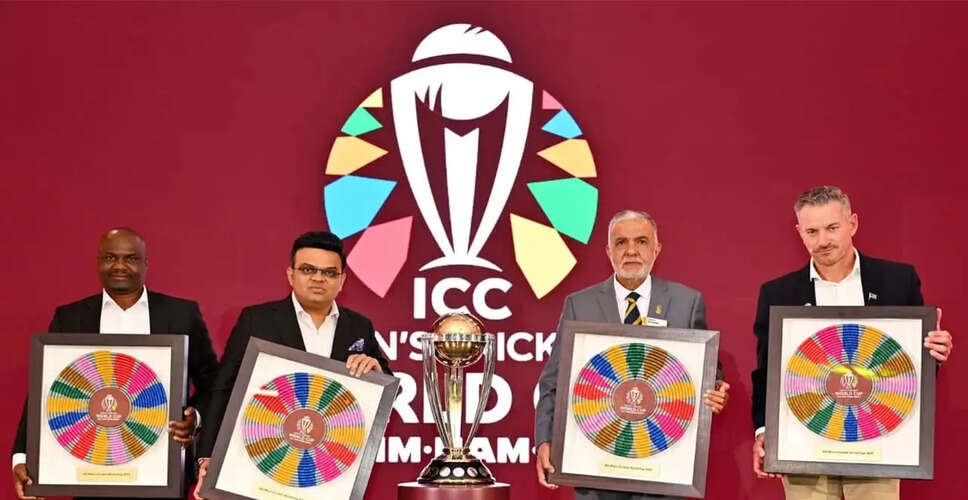
The journey towards the 2027 ICC Cricket World Cup officially commenced with the unveiling of the tournament's logo and hosting venues in Johannesburg on Thursday.
This prestigious event will be co-hosted by South Africa, Zimbabwe, and Namibia.
According to a press release from his office, Shah remarked, 'This marks an exciting milestone on the road to the ICC Men's Cricket World Cup 2027.'
'The unveiling of the host cities and the tournament brand signifies the beginning of a journey that will unite fans globally and build excitement for one of cricket's largest events.'
'The return of this esteemed tournament to Africa after 24 years is a landmark moment for cricket. We are confident that South Africa, Zimbabwe, and Namibia will deliver an unforgettable event, showcasing the warmth, passion, and rich diversity that make this region truly unique,' he concluded.
Venues Announced for the 2027 World Cup
A grand ceremony in Johannesburg revealed the 12 venues selected for the ICC Men's Cricket World Cup next year, featuring eight cities from South Africa, three from Zimbabwe, and Namibia's capital, Windhoek.
This marquee 50-over tournament will return to Africa after 24 years, with the three nations set to host the 2027 ICC Men's Cricket World Cup.
The last time the tournament was held in Africa was in 2003, co-hosted by South Africa, Zimbabwe, and Kenya.
Theme: 'Ubuntu' and 'Three Nations, One Heartbeat'
The 14th edition of the World Cup will include the world's top 14 teams, driven by the theme 'Three Nations, One Heartbeat,' which celebrates the shared spirit, diversity, and community values of the three host nations.
Embracing the African philosophy of 'Ubuntu,' meaning 'I am, because we are,' the tournament aims to highlight compassion, unity, and human connection.
Aligned with the 'Make the Circle Bigger' vision, the 2027 World Cup will showcase Africa's rich cultural diversity, including its many traditions, 29 officially recognized languages, and a wide range of identities united through cricket.
Host Venues in Detail
South Africa will host matches at eight venues, including:
1. Wanderers Stadium, Johannesburg
2. SuperSport Park, Centurion
3. Newlands Cricket Ground, Cape Town
4. Kingsmead Cricket Ground, Durban
5. St George's Park, Gqeberha
6. Mangaung Oval, Bloemfontein
7. Boland Park, Paarl
8. Buffalo Park, KuGompo City (formerly East London).
Zimbabwe will host games at:
1. Harare Sports Club, Harare
2. Queens Sports Club, Bulawayo
3. Fale Mosi-oa-Tunya International Cricket Stadium, Victoria Falls.
Namibia's capital, Windhoek, will host matches at the Namibia Cricket Ground.
The unveiling ceremony was attended by South African cricket legends, including Graeme Smith, Makhaya Ntini, Hashim Amla, Temba Bavuma, and Kagiso Rabada, along with Zimbabwe's Hamilton Masakadza and Namibia's Rudolf Jansen van Vuuren.
Host Nations' ICC Event History
Since co-hosting the 2003 ICC Men's Cricket World Cup, South Africa has hosted several major ICC events, including the inaugural ICC Men's T20 World Cup in 2007, the ICC Women's T20 World Cup in 2023, and the ICC Under-19 Men's Cricket World Cups in 2020 and 2024.
Zimbabwe, which also co-hosted the 2003 World Cup, will return as a host nation, while Namibia will stage its first-ever senior ICC event. Both countries recently hosted the ICC Under-19 Men's Cricket World Cup earlier this year.
New Tournament Format Introduced
The ICC Men's Cricket World Cup 2027 will feature 57 matches and introduce a new three-stage format designed to enhance competitiveness, add context to games, and provide fans with a more engaging tournament experience.
The tournament will kick off with a Super Series involving the three lowest-ranked teams (12th to 14th), competing in a round-robin format. The winner will progress to the next stage.
The subsequent round will consist of 12 teams divided into two groups of six, with each team playing a round-robin schedule. The top three teams from each group, along with the best fourth-placed team, will qualify for the Super 7 stage.
The Super 7 phase will include 21 round-robin matches, with the top four teams advancing to the semi-finals. The leading team will face the fourth-placed team, while the second-ranked team will compete against the third-placed team for a spot in the final.