
Revolutionary Discovery: New 2D Material with i-Wave Altermagnetism Unveiled by IIT Bhubaneswar
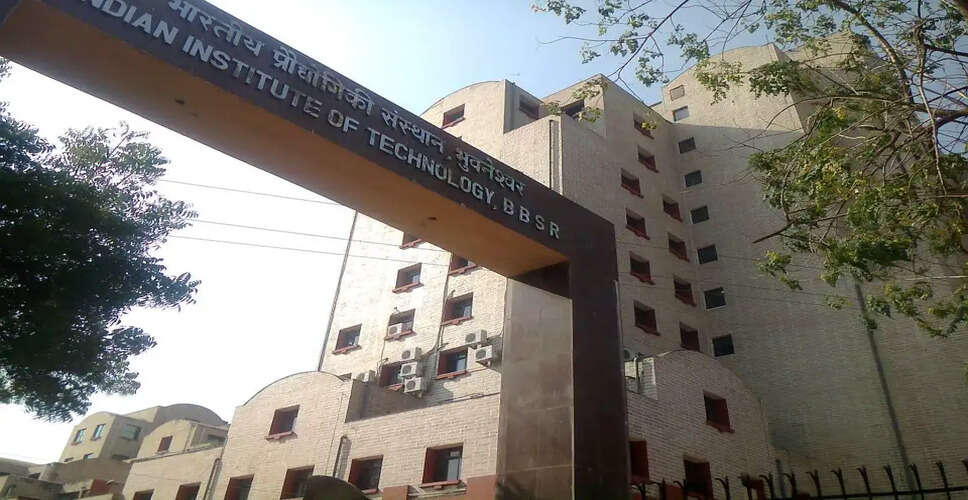

Groundbreaking Research from IIT Bhubaneswar
Bhubaneswar: A team of researchers from the Indian Institute of Technology (IIT) Bhubaneswar, in partnership with Virginia Commonwealth University in the USA, has made a theoretical breakthrough by predicting a novel two-dimensional material that showcases i-wave altermagnetism.
This discovery holds the potential to revolutionize the development of electronic devices that are not only faster but also more compact and energy-efficient. The applications could span high-density memory, spin-based transistors, terahertz communication, and advanced quantum technologies, as highlighted in a statement from IIT.
The research, spearheaded by Manish Kumar Mohanta from the Department of Physics at IIT Bhubaneswar, has been published in the prestigious journal Nano Letters, which focuses on nanoscience and nanotechnology.
Altermagnetism is gaining traction in condensed matter physics due to its unique combination of properties found in both traditional magnets and antiferromagnets.
Unlike standard magnets, altermagnetic materials generate minimal stray magnetic fields, allowing for closer placement of electronic components without the risk of magnetic interference, according to the institute.
Additionally, these materials are capable of generating and controlling spin-polarized electrical currents, a crucial aspect for the advancement of spintronics.
In contrast to conventional electronics that rely solely on the electric charge of electrons for information processing, spintronics leverages the intrinsic spin of electrons, paving the way for devices that are faster and more energy-efficient.
The research indicates that a monolayer of FeCl₃, just three atoms thick, exhibits a rare form of i-wave symmetry altermagnetism.
This intricate magnetic state could facilitate precise manipulation of electron spins, offering a promising foundation for the creation of ultrafast, low-power electronic technologies.
As the demand for high-speed computing systems that are energy-efficient continues to rise, this discovery points towards a new avenue for designing future electronic devices that enhance speed, efficiency, and reliability. Such innovations could eventually impact a wide range of technologies, including data storage, artificial intelligence hardware, wearable electronics, terahertz devices, and quantum information systems.
Manish Kumar Mohanta emphasized that this finding broadens the spectrum of altermagnetic materials and lays the groundwork for developing practical spintronic devices that could surpass current technologies in speed, compactness, and energy efficiency.