
Revealing Insights: How Olive Ridley Turtles Navigate Odisha's Coastline
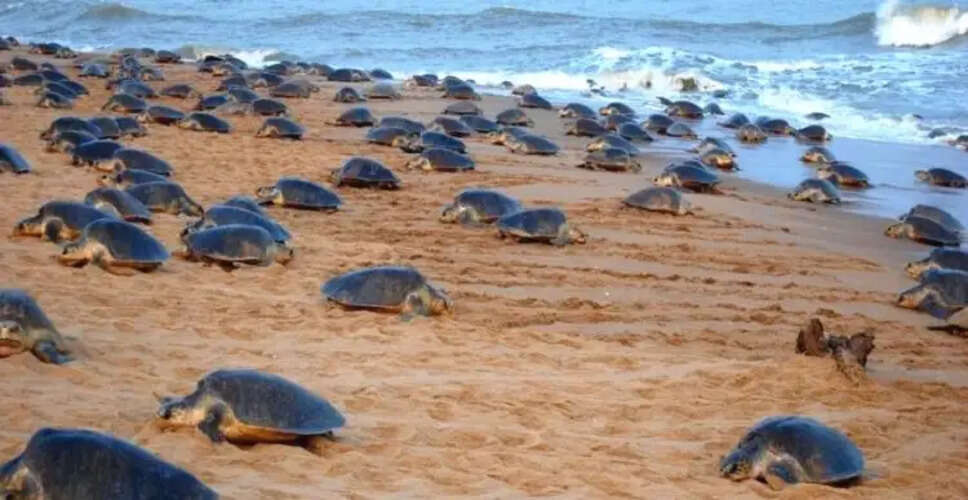

New Study Unveils Movement Patterns of Olive Ridley Turtles
Bhubaneswar/Kendrapada: A recent study has revealed that Olive Ridley turtles, which gather in large numbers for their annual nesting on the coast of Odisha, exhibit different movement and habitat usage patterns based on gender.
This research is part of the initial findings from a three-year project conducted by the Wildlife Institute of India (WII), in collaboration with the Odisha Wildlife Organisation, the Department of Forest, Environment & Climate Change, Dhamra Port Co Ltd (DPCL), and the Adani Foundation.
On Saturday, Odisha's Minister for Forest, Environment and Climate Change, Ganesh Ram Singhkhuntia, unveiled the first-year report of this significant research initiative led by WII based in Dehradun.
The study utilized satellite telemetry, boat surveys, and shoreline assessments to gain insights into how Olive Ridley turtles navigate Odisha's coastal waters and their nesting environments.
According to the telemetry data, male Olive Ridley turtles initiate their offshore migration earlier than females, who tend to stay in nearshore waters for extended periods. The findings also suggest potential foraging stops along the continental shelf and throughout the Bay of Bengal.
Notably, one female turtle was tracked traveling an impressive 6,719 km over 271 days, reaching waters east of Sri Lanka. Another turtle journeyed nearly 200 km from Gahirmatha in Kendrapada district to Rushikulya in Ganjam district and back, showcasing the extensive movement of Olive Ridleys along Odisha's coastline.
During the 2025-26 nesting season, boat surveys recorded 1,390 individual turtles and 67 mating pairs, with most sightings occurring within two kilometers of the shore. The report emphasizes the need for ongoing monitoring to better understand how these movement and habitat usage patterns may impact the conservation of nesting sites.
Odisha is home to some of the most crucial Olive Ridley nesting locations globally, including Gahirmatha in Kendrapada and Rushikulya in Ganjam, where mass nesting events occur.
As a species protected under Schedule I of the Wildlife Protection Act, 1972, Olive Ridley turtles enjoy the highest level of legal protection in India.
The initial fieldwork concentrated on the Gahirmatha rookery, with satellite tagging efforts at both Gahirmatha and Rushikulya. The report also notes that APSEZ operates the Dhamra and Gopalpur ports in Odisha.
Dr. R. Suresh Kumar, a Senior Scientist at WII, stated, "This study represents a revival of satellite tracking for Olive Ridley turtles in Odisha after nearly 15 years. Our collaboration with the Odisha Forest Department, Dhamra Port, and the Adani Foundation has allowed us to gather new insights into the movement and habitat use of these turtles. The findings will serve as a scientific basis for evidence-based conservation strategies. We aim to continue tracking more turtles to enhance our dataset, which will support effective management and long-term conservation efforts."