
INS Aridaman: India's Latest Nuclear Submarine Enhances Naval Strength
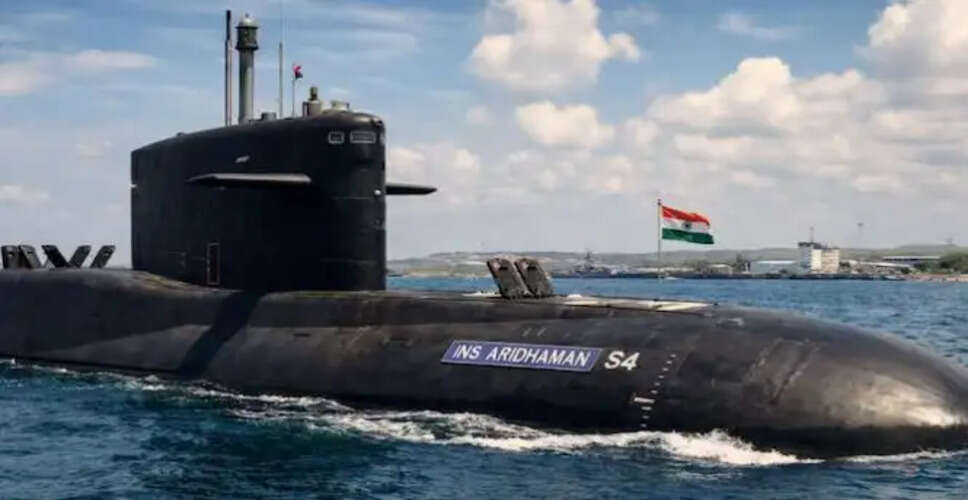
India's Newest Nuclear Submarine Commissioned
New Delhi: On Friday, India officially launched its third domestically constructed nuclear-powered ballistic missile submarine, INS Aridaman, marking a significant enhancement to the country's nuclear triad capabilities, according to reliable sources.
While there has been no formal announcement regarding the submarine's commissioning, it comes at a time when regional security dynamics are rapidly changing.
The program for India's nuclear-powered ballistic missile submarines (SSBN) is highly confidential. The first vessel in this initiative was INS Arihant, followed by INS Arighat.
INS Arihant, India's inaugural indigenous nuclear submarine, was launched in July 2009 and entered service in 2016. The second submarine, INS Arighat, was commissioned in August 2024. SSBN stands for ship submersible ballistic nuclear.
This SSBN initiative is crucial for India's nuclear deterrent strategy.
The addition of INS Aridaman is viewed as a pivotal step in strengthening India's strategic strike capabilities.
India joins an elite group of nations, including the US, Russia, the UK, France, and China, that operate nuclear-powered submarines.
After extensive sea trials, INS Aridaman was commissioned, with Defence Minister Rajnath Singh and Navy Chief Admiral Dinesh K Tripathi present at the ceremony held at a southern naval base.
In a cryptic social media message, Singh remarked, "It's not words but power, 'Aridaman'."
While India has established air and land-based nuclear capabilities, it is now prioritizing the enhancement of its underwater nuclear capabilities.
Plans are underway for a fourth nuclear-powered submarine, as confirmed by Admiral Tripathi in December, who stated that another SSBN would soon be inducted into service.
India has consistently advocated for global nuclear disarmament aimed at the complete eradication of nuclear weapons.
The 1998 Pokhran-II nuclear tests by India elicited strong international reactions.
Post-tests, India asserted that these actions were necessary for maintaining 'credible minimum deterrence' and committed to a 'no first use' policy.
In 2003, India formally articulated its nuclear doctrine, emphasizing the 'no first use' stance.
Earlier that day, the Indian Navy also commissioned a new warship, INS Taragiri, in Visakhapatnam, with Singh in attendance.
During the commissioning, Singh highlighted that INS Taragiri symbolizes India's advancing technological capabilities, self-reliance, and formidable naval strength.
"This vessel is designed for high-speed operations and can remain at sea for extended durations. It is equipped with systems to monitor enemy activities, ensure its own safety, and respond swiftly if needed," he stated.
"It boasts advanced radar, sonar, and missile systems, including BrahMos and surface-to-air missiles, enhancing its operational effectiveness," he added.