
Indian Astronaut Shubhanshu Shukla Returns from Historic Space Mission
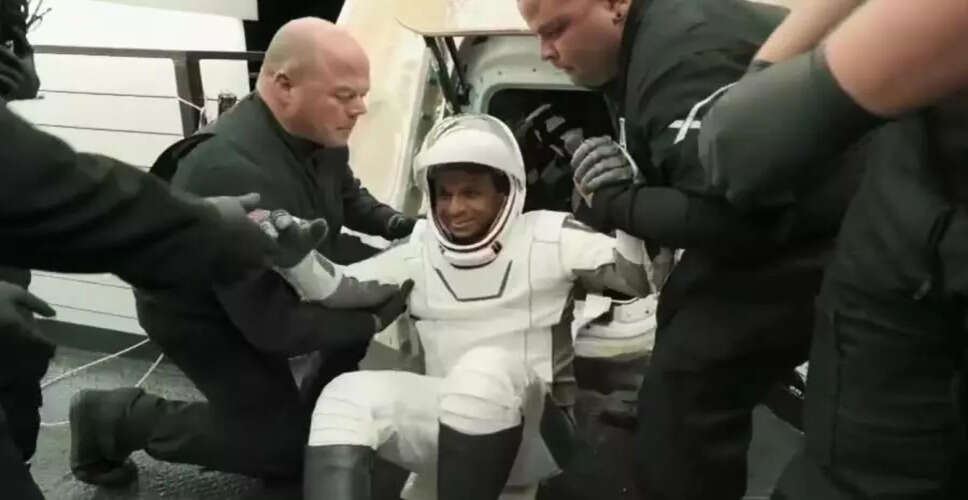
Historic Return of Dragon Spacecraft
New Delhi, July 15: The Dragon spacecraft, which transported astronaut Shubhanshu Shukla, has successfully returned to Earth after an 18-day mission aboard the International Space Station (ISS). This journey not only included scientific research and seed samples but also highlighted India's expanding ambitions in space exploration.
The spacecraft, which carried Shukla along with commander Peggy Whitson and mission specialists Slawosz Uznanski-Wisniewski from Poland and Tibor Kapu from Hungary, splashed down off the coast of San Diego, California, concluding a 22.5-hour journey from the ISS.
SpaceX confirmed the splashdown via social media, welcoming back the crew: "Splashdown of Dragon confirmed - welcome back to Earth, @AstroPeggy, Shux, @astro_slawosz, and Tibi."
Following the splashdown, SpaceX recovery boats approached the spacecraft to transport it to the recovery ship Shannon, where the astronauts would exit the capsule.
The Axiom-4 crew will undergo medical evaluations aboard the ship before taking a helicopter ride back to land.
After returning to Earth, the astronauts are expected to spend a week in rehabilitation to readjust to gravity after their time in the weightlessness of space.
Shubhanshu Shukla: A Milestone for India
Group Captain Shukla, a 39-year-old officer in the Indian Air Force and test pilot, completed his first space mission as part of the Axiom-4 project, a commercial spaceflight supported by ISRO and NASA, and operated by Axiom Space.
This mission is significant for India, as Shukla is the first Indian to visit the ISS and only the second Indian to travel into space, following Rakesh Sharma's historic flight in 1984.
Born on October 10, 1985, in Lucknow, Shukla grew up in a middle-class family without direct ties to aviation or space. His passion for flying ignited during a childhood visit to an airshow.
His sister, Suchi Shukla, recalled, "As a child, he had once been to an air show and was fascinated by the speed and sound of the aircraft. That's when he first spoke about flying."
Last year, Shukla was selected as one of four astronauts for India's Gaganyaan program, alongside Prasanth Balkrishnan Nair, Angad Pratap, and Ajit Krishnan.
The team underwent rigorous training at Russia's Gagarin Cosmonaut Training Centre and ISRO's Astronaut Training Facility in Bengaluru. However, before Gaganyaan's anticipated launch in 2027, Shukla had the chance to participate in the Ax-4 mission, marking the first Indian human spaceflight in 41 years.
Scientific Contributions and Experiments
During his time aboard the ISS, Shukla served as the pilot for the Axiom-4 mission, collaborating with commander Peggy Whitson and mission specialists from Poland and Hungary. They conducted scientific experiments and engaged with students and space enthusiasts worldwide.
Shukla led seven India-focused microgravity experiments across various fields, including life sciences, agriculture, space biotechnology, and cognitive research.
A notable experiment involved planting moong and methi seeds in petri dishes to observe their growth in microgravity, which will be analyzed upon their return to Earth. This research aims to understand how microgravity affects plant development and genetic expression, crucial for future space farming.
Additionally, he explored the potential of cyanobacteria and microalgae for producing food, oxygen, and biofuels in space, which could be vital for sustainable life-support systems during long-duration missions.
Shukla also participated in stem cell research to investigate whether supplements can aid in injury recovery and tissue regeneration in space.
"It's been great to work in the Glove Box doing this research. I feel proud to be a bridge between scientists on Earth and the station," Shukla remarked.
One of his lighter experiments involved creating a floating water bubble in zero gravity, where he humorously referred to himself as a "water bender" while demonstrating how surface tension manipulates light in space.
Looking Ahead
Shukla's mission concluded with the Dragon 'Grace' spacecraft's splashdown near California, but his journey is far from over.
With Gaganyaan on the horizon and new opportunities in space research emerging, his experiences are expected to play a crucial role in shaping India's human spaceflight program.
As Shukla expressed from the ISS, "I want each one of you to be part of this journey. Let us embark on India's human space program together."