
How Ukraine's Low-Cost Drones Could Shift the Balance in Global Warfare
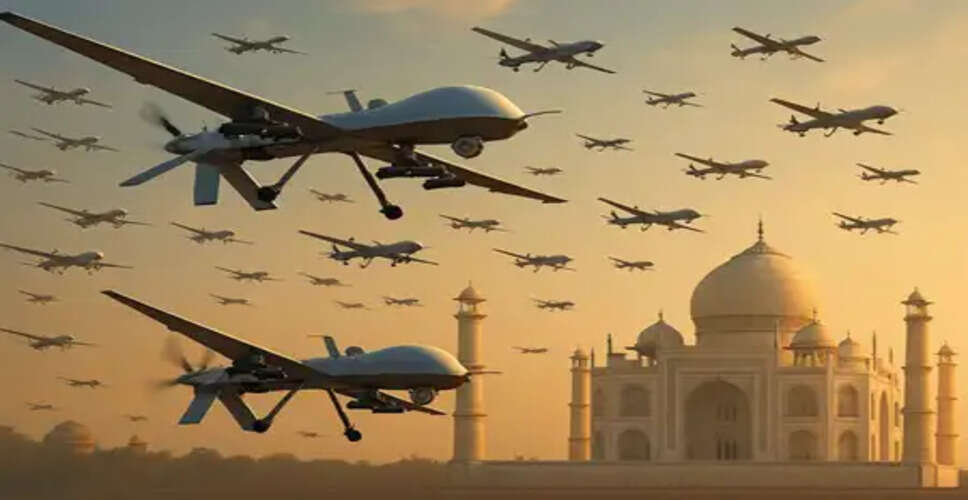
Kyiv's Innovative Approach to Drone Warfare
Kyiv: Amid the ongoing conflict in the Middle East, the United States is facing a depletion of missile supplies, prompting Ukraine to leverage its advancements in low-cost interceptors designed to neutralize Russian drones.
As a prominent manufacturer of these interceptors, Ukraine is extending its expertise to the US and Gulf nations, seeking advanced weaponry in exchange.
Since the onset of Russia's full-scale invasion four years ago, Ukraine's arms industry has transformed from a struggling entity to a burgeoning defense sector focused on affordable drones, specifically engineered to counter the Iranian-style Shahed drones that Russia deploys in large numbers.
In response to a recent US request for assistance against Iranian Shahed drones, President Zelenskyy has ordered the deployment of Ukrainian technology and personnel, although specifics remain classified.
Initially, Ukraine had prohibited arms exports when the war began in 2022, but now, manufacturers of low-cost interceptors report growing interest from the US and Gulf states.
Ukraine's Unique Position in Drone Production
Oleh Katkov, editor-in-chief of Defence Express, emphasized that while other nations can produce interceptor drones, Ukraine is the only country with a mass-produced system that has been battle-tested. He noted the significant difference between a proven system and mere promises of development, likening it to selling a fully constructed house rather than just the materials.
If Ukraine successfully collaborates with international partners, it could establish itself as a key player in modern warfare. However, questions remain about whether its industry can scale up to meet global demands without jeopardizing its own defense capabilities.
The Challenge of Patriot Missiles
The rising interest from Gulf nations coincides with their rapid depletion of costly Patriot missiles, which they have been using to intercept the more affordable Shahed drones from Iran.
An Iranian Shahed drone is priced around $30,000, while a single interceptor missile for the US-made Patriot system can cost millions.
Lockheed Martin announced it produced a record 600 PAC-3 MSE interceptors for Patriot systems in 2025. Zelenskyy claimed that Middle Eastern countries used over 800 such missiles in just three days, surpassing Ukraine's entire reserve throughout the four-year conflict.
To combat the Shahed drones, Ukraine has developed low-cost interceptors priced between $1,000 and $2,000, transitioning from prototypes to mass production within months in 2025.
However, Ukraine lacks a defense mechanism against ballistic missiles, making the acquisition of Patriot missiles a critical issue for Kyiv.
Prospects and Challenges in Arms Exports
In light of these developments, Zelenskyy is proposing a trade with allies, stating, "Our message is straightforward: we seek to quietly receive the Patriot missiles we need and offer a corresponding number of interceptors in return."
Despite Zelenskyy's enthusiasm, analysts caution that entering the global arms market is complex and requires more than just contracts.
Yevhen Mahda, executive director of the Kyiv-based Institute of World Policy, highlighted that the arms trade is a delicate arena dominated by the US, and it would be naive to assume that markets will open simply because Ukraine has a compelling narrative.
Ukrainian officials have recently begun discussing a transition from a wartime weapons export freeze to a regulated market, but the timeline and implementation of such a system remain uncertain.
"We need more than just presidential statements; we need action," Mahda asserted. "How can we discuss exports if we aren't officially selling anything yet?"
Interest from the US and Gulf States
The US and Gulf nations, including the UAE, Bahrain, Saudi Arabia, and Qatar, have repeatedly expressed interest in Ukraine's domestically produced interceptors, according to several Ukrainian arms manufacturers.
Neither the US nor Gulf countries provided immediate comments regarding these requests.
"We are prepared to share our technology and want to assist," stated Marco Kushnir, a spokesperson for General Cherry, a Ukrainian manufacturer known for its effective interceptors against Shahed drones.
Kushnir mentioned that the decision ultimately lies with the government and Zelenskyy, but the company is ready to assist partners within days, claiming they have the capacity to produce tens of thousands of interceptors monthly.
Training and Integration Challenges
Currently, Ukraine has a surplus of interceptor drones, with manufacturers asserting they could produce tens of thousands more without compromising national defense. The primary challenge lies in training personnel and integrating the drones with radar systems capable of long-range target detection.
Several Ukrainian companies have already deployed effective systems. General Cherry's Bullet interceptor, developed in late 2025, has successfully downed hundreds of Shahed drones, according to Kushnir. Another model, Skyfall's 3D-printed P1-Sun, costs around $1,000 and can achieve speeds exceeding 300 kilometers (186 miles) per hour, with a production capacity of up to 50,000 drones monthly.
While the legal framework for hardware exports remains uncertain, Ukraine's most significant asset is its human expertise. Zelenskyy has frequently stated that Ukraine is ready to send instructors to train foreign personnel on using the interceptors.
"Providing the drones won't be an issue," said Andrii Taganskyi, director of the Camera Business at Odd Systems, which supplies cameras for interceptor drones made by another Ukrainian firm, Wild Hornets. "However, training foreign crews to operate the systems and adapt tactics is crucial."
Interceptor drones are not standalone products; they must be integrated into a comprehensive radar system for effective target detection and tracking. Although some models are partially automated, manufacturers stress that crews still require training for optimal use.
"This is a tool that necessitates training," Katkov noted. "The real, proven expertise exists only in Ukraine."
Kyiv's willingness to send specialists abroad represents a significant strategic sacrifice, given the impact on Ukraine's air defense capabilities. With ongoing drone attacks from Russia, every trained soldier is a critical asset.
"We do not have a surplus of military personnel at the front," Katkov remarked. "However, there is a clear understanding that the potential benefits of such cooperation may outweigh the risks."