
Concerns Rise Over Government's Mandatory Cybersecurity App for Smartphones
Opposition Voices Alarm Over New Directive
On Tuesday, leaders from the opposition and experts in technology policy raised alarms regarding the Union government's recent mandate requiring smartphone manufacturers to pre-install a government cybersecurity application on all new devices. They argue that this move represents an increase in surveillance without sufficient protections for user privacy.
This directive was issued by the Department of Telecommunications last Friday.
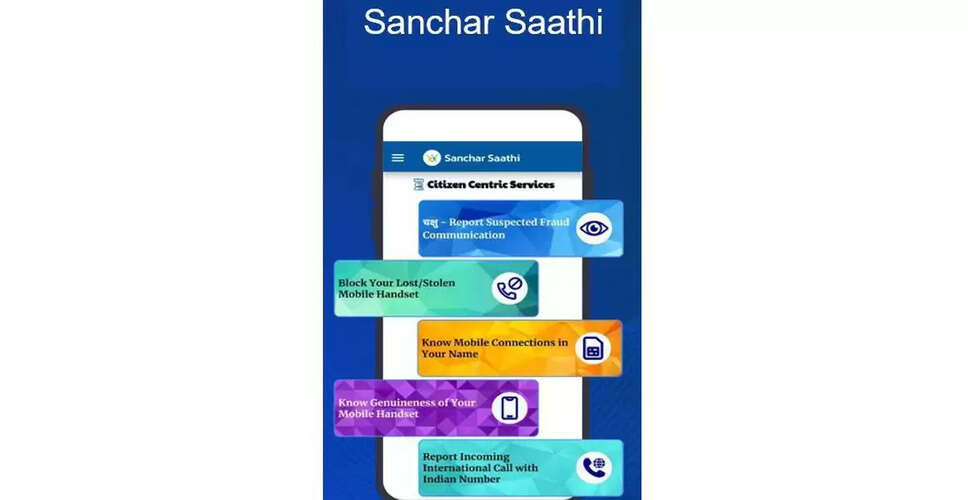
Manufacturers are instructed to include the Sanchar Saathi app on new smartphones and to update existing devices with the application. According to the Ministry of Communications, users will not have the option to uninstall this app.
In response to the backlash, Union Communications Minister Jyotiraditya Scindia stated that users would indeed have the ability to delete the app.
Electronics manufacturers have been given a three-month deadline to comply with this order.
The Congress party criticized the telecom department's directive as 'unconstitutional' and called for its immediate retraction.
Party leader KC Venugopal emphasized that 'Big Brother cannot watch us,' asserting that the right to privacy is a fundamental aspect of life and liberty.
He described the pre-installed government app as a 'dystopian tool' for monitoring citizens, claiming it would track every action and decision of individuals.
Venugopal further stated that this directive is part of a broader pattern of attacks on constitutional rights.
Congress leader Priyanka Gandhi Vadra labeled the Sanchar Saathi app a 'snooping app,' insisting that individuals should have the right to communicate privately without government oversight. She criticized the government's approach, suggesting it is transforming the nation into a dictatorship.
Vadra remarked, 'There’s a very fine line between reporting fraud and monitoring every citizen's phone activity. This is not how it should function.'
While acknowledging the necessity for enhanced cybersecurity, she argued that it does not justify government intrusion into personal devices.
John Brittas, a member of the Communist Party of India (Marxist), described the directive as a 'blatant invasion' of privacy.
This issue was also brought up in Parliament on Tuesday.
During a discussion in the Rajya Sabha, Congress MP Renuka Chowdhury remarked that the Modi government employs various tactics to undermine democracy, with the Sanchar Saathi app being yet another tool that infringes on citizens' rights.
Scindia defended the app, stating it is designed to enhance user safety.
'When the opposition has no real issues, they seek to create them. Our responsibility is to protect consumers and ensure their safety,' he asserted.
Digital Rights Groups Raise Concerns
Digital Rights Group Critiques Directive
The Internet Freedom Foundation, a digital rights organization, expressed that the directive represents a 'deeply concerning expansion' of governmental control over personal digital devices.
They argue that the methods chosen to combat International Mobile Equipment Identity fraud are excessive, legally questionable, and detrimental to user privacy and autonomy.
The requirement that the app's functionalities cannot be disabled effectively turns every smartphone into a platform for state-mandated software that users cannot refuse or remove.
For the app to function, it would likely require system-level access to devices, which undermines the safeguards that typically prevent one application from accessing the data of others, thereby making Sanchar Saathi a permanent, non-consensual access point within the operating system of every smartphone user in India.
IFF's Statement on the Sanchar Saathi App Pre-Installation Directive
— Internet Freedom Foundation (IFF) (@internetfreedom) December 2, 2025
The Department of Telecommunications (DoT), specifically its AI & Digital Intelligence Unit (AI & DIU) on 21st November, 2024 has under the Telecommunications (Telecom Cyber Security) Rules, 2024 issued a…
The organization contended that the mandatory installation of the app fails to meet the proportionality standards established by the 2017 KS Puttaswamy judgment, which recognized the right to privacy as a fundamental right. This standard requires that any infringement on privacy must adhere to legality, necessity, and proportionality.
They also noted that the directive is vague, suggesting that while the app is currently presented as a harmless IMEI checker, it could be repurposed through server-side updates for invasive monitoring, such as scanning for banned applications or tracking SMS logs under the guise of fraud detection.
The foundation criticized the Union government for expecting smartphone users to accept an 'open-ended, updatable surveillance capability' on their personal devices without the essential protections that a constitutional democracy should guarantee.
Technology policy expert Pranesh Prakash questioned the need for the Sanchar Saathi app, given that the government already operates a Central Equipment Identity Register to blacklist IMEI numbers.
'All telecom networks in India have EIRs to check and block spoofed/null IMEIs and reported IMEIs (of stolen phones) with the Indian government running a CEIR,' he stated. 'I still haven't heard a convincing argument for why having this app pre-installed at the device level is beneficial.'
All telecom networks in India have EIRs to check and block spoofed/null IMEIs and reported IMEIs (of stolen phones) with the Indian govt running a CEIR.
— Pranesh Prakash (@pranesh) December 2, 2025
I still haven't heard a good argument as to why having this app pre-installed at a device level is helpful. https://t.co/0hw1KY0Jf8