
Revolutionary Food Safety Technology: NIT Rourkela's New Patent for Adulteration Detection
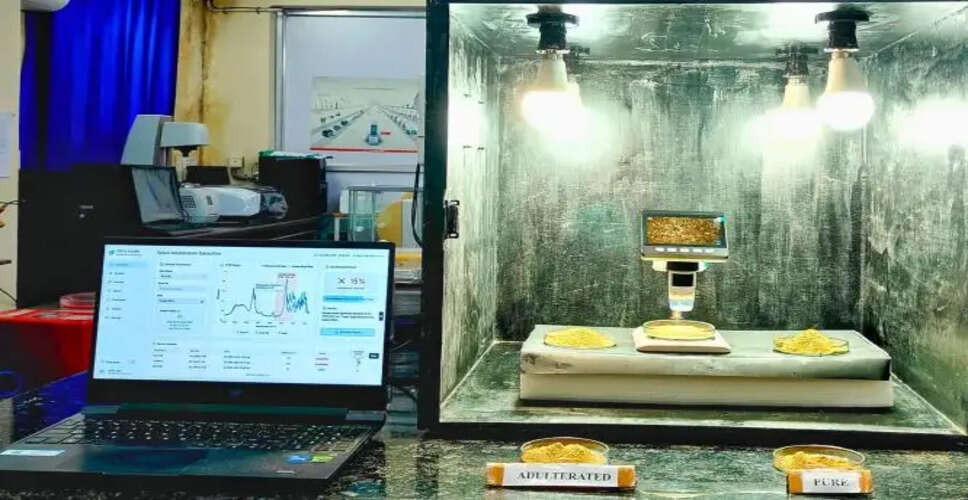

Innovative Detection System Developed at NIT Rourkela
Rourkela: A team of researchers at the National Institute of Technology Rourkela has successfully obtained a patent for an innovative system designed to swiftly detect and quantify adulteration in spices and various food items through the use of infrared spectroscopy combined with machine learning.
This cutting-edge technology integrates Fourier Transform Infrared (FTIR) spectroscopy with sophisticated algorithms, allowing for the identification of adulterants and their concentrations in mere seconds. This presents a significant improvement over traditional laboratory methods, which are often lengthy and resource-demanding.
Unlike current methods that merely indicate the presence of adulterants, this new system offers quantitative data, making it ideal for immediate application in quality control labs and food processing facilities, according to the institute.
The findings, published in the journal Food Chemistry, were the result of collaborative efforts by assistant professor Sushil Kumar Singh, the late Poonam Singha, and M.Tech. student Rishabh Goyal from the Department of Food Process Engineering. They have secured a patent titled 'Method and System for Detecting and Quantifying Adulteration in Food Stuff.'
In a practical demonstration, the system successfully identified sawdust in coriander powder with an accuracy of approximately 92%, showcasing its effectiveness in detecting prevalent adulteration practices in spices. Singh noted that this technology could be seamlessly integrated into industrial workflows, facilitating rapid screening and enhancing adherence to food safety regulations, especially in cost-sensitive markets like India. The research team aims to partner with industry stakeholders for pilot testing and to broaden the system's capabilities to identify a wider array of food adulterants.