
North Korea's Hypersonic Missile Test: What It Means for Global Security
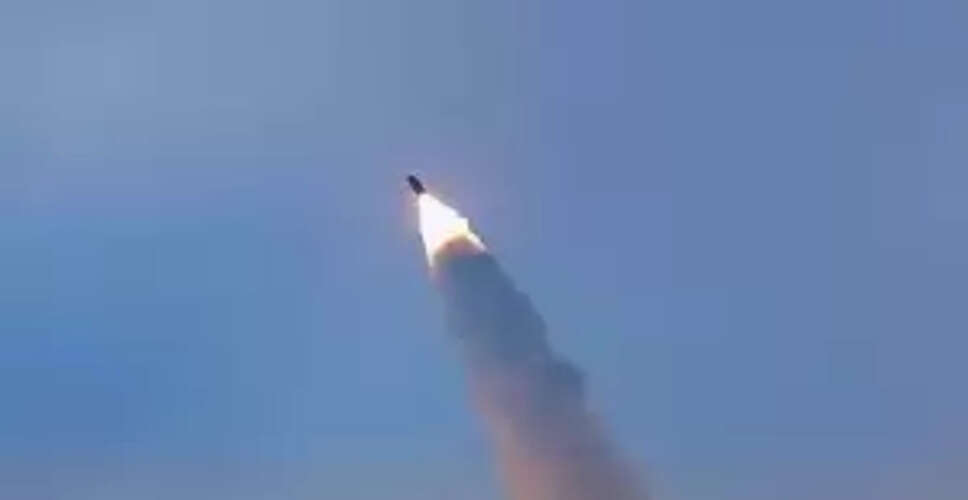
North Korea Conducts Successful Hypersonic Missile Test
Seoul: North Korea successfully launched hypersonic missiles from Pyongyang, hitting targets in the East Sea, as reported by state media on Monday. The event was attended by leader Kim Jong-un.
According to the Korean Central News Agency (KCNA), a sub-unit of the Korean People's Army executed a missile drill to assess the nation's war deterrence capabilities and the operational readiness of its weapon systems.
The missile launch was detected by South Korea's military at 7:50 a.m. on Sunday, just hours before President Lee Jae Myung's departure for a summit with Chinese President Xi Jinping, following a significant U.S. military operation that captured Venezuelan leader Nicolas Maduro.
Kim Jong-un stated that the drill confirmed the completion of a crucial technological task for national defense, showcasing the readiness of North Korea's nuclear forces.
The Democratic People's Republic of Korea (DPRK) leader emphasized that the country has placed its nuclear capabilities on a practical footing, preparing them for potential conflict and stressing the need for continuous upgrades to military assets, particularly offensive systems.
Kim articulated that the ongoing activities are aimed at enhancing the nuclear deterrent, citing recent geopolitical tensions as justification for these developments.
While the KCNA did not clarify the specific geopolitical crisis referenced, North Korea's foreign ministry condemned the U.S. military action against Maduro, labeling it a severe violation of sovereignty.
The hypersonic missiles reportedly struck targets located 1,000 kilometers away in the East Sea, launched from the Ryokpho District in Pyongyang.
Kim expressed gratitude to the military unit responsible for the drill and extended New Year greetings to all missile force personnel.
He urged the missile forces to remain dedicated to their mission of safeguarding the DPRK's sovereignty and security through disciplined and responsible combat readiness.
Accompanying Kim during the missile launch were Kim Jong-sik, vice department director of the ruling party's Central Committee, and Jang Chang-ha, head of the Missile Administration.
Although the KCNA did not specify the missile types used, South Korea's military speculated they could be the Hwasong-11Ma, a hypersonic missile developed by modifying the KN-23 missile.
This missile was first showcased during a military parade in October of the previous year and underwent its initial test launch shortly thereafter.
The Korea Defence Forum, a nonprofit organization, noted that while last year's test focused on short-range flight and precision, the recent test likely aimed to evaluate range and low-altitude glide capabilities.