
China's Naval Ambitions: Is a Nuclear-Powered Aircraft Carrier on the Horizon?

Beijing's Naval Aspirations
A recent video from the Chinese navy has ignited discussions regarding the potential for a nuclear-powered fourth aircraft carrier currently under construction. This video, titled 'Into The Deep,' was unveiled on Wednesday to commemorate the 77th anniversary of the People's Liberation Army Navy, illustrating the navy's evolution from coastal defense to broader maritime ambitions.
The footage showcased the capabilities of China's blue-water navy, featuring real-life exercises conducted in the western Pacific and the use of sophisticated technology.
Additionally, the video depicted a compass passed down through generations of naval officers, named after the existing aircraft carriers: Liaoning, Shandong, and Fujian. A fourth name, He Jian, was introduced, which may suggest a nuclear-powered vessel, as 'He' is phonetically similar to the Chinese term for nuclear, while 'Jian' translates to ship, according to reports from a Hong Kong-based media outlet.
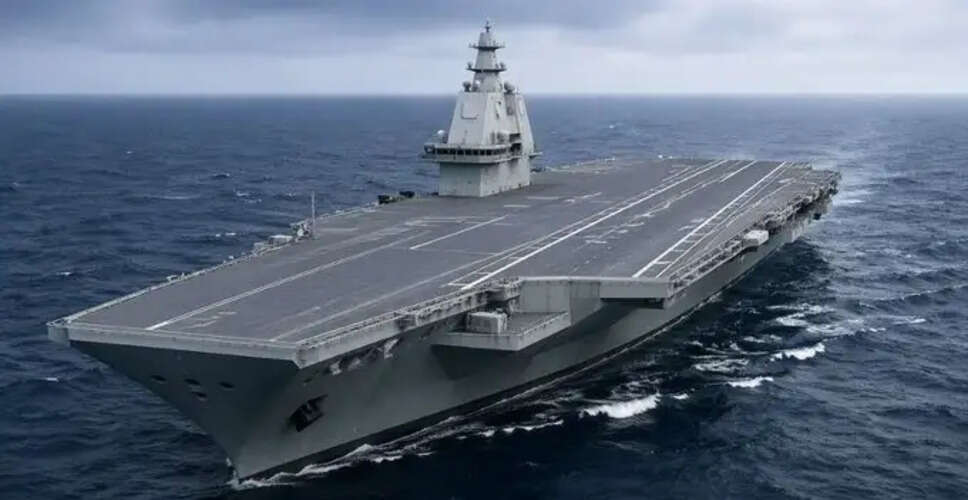
While China has not officially acknowledged the construction of a new carrier, satellite imagery from recent years indicates a significant vessel is being built at a shipyard in Dalian, located in the country's northeast.
These images imply that the new ship could be comparable in size to the US's nuclear-powered Gerald R. Ford-class carriers, raising questions about the propulsion technology that might be employed.
Further evidence includes photographs taken in February that revealed structures resembling nuclear reactor containment units.
In November of last year, China launched its third aircraft carrier, the Fujian, which is touted as the most advanced warship in its fleet, featuring electromagnetic catapults. This event was attended by President Xi Jinping.
The Fujian is equipped with an electromagnetic aircraft launch system (EMALS), a technology currently exclusive to the American USS Gerald R. Ford.
China was relatively late in adopting aircraft carriers compared to other major nations, with its first carrier, the Liaoning, being a refurbished Soviet ship commissioned in 2012, followed by the indigenous Shandong in 2019.
The Fujian has been commissioned after successful training of carrier-based aircraft, including the J-15T, J-35, and KongJing-600, which have completed catapult-assisted take-offs and landings.
All three carriers are conventionally powered, with the Fujian being the largest, displacing 80,000 tonnes.
Analysts suggest that as tensions with the US escalate, China may pursue the construction of additional aircraft carriers to secure various maritime routes globally.
With the Fujian now operational, China might also increase its naval presence in the Indian Ocean and Arabian Sea, where it has established bases in Djibouti, Gwadar in Pakistan, and the commercial port of Hambantota in Sri Lanka, acquired through a debt swap.
Recent reports indicate that the Chinese navy has the largest active fleet globally, boasting 234 warships, compared to the US Navy's 219.
However, the US Navy maintains its superiority with 11 nuclear-powered aircraft carriers.
The Indian Navy, operating two carriers—INS Vikrant and INS Vikramaditya—is also advancing its capabilities by commissioning additional naval vessels to uphold its influence in the Indian Ocean.