
Youth Initiative Transforms Jorhat Sandbank into 'Zubeen Seuj Chapori'

A Green Tribute to Zubeen Garg
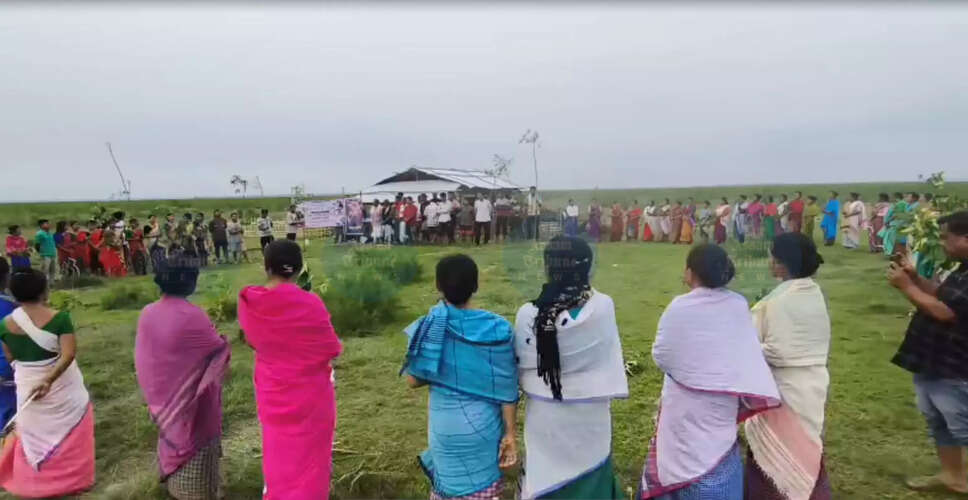
Group of youth and local residents gathered to plant saplings in Teok's Jajimukh, Jorhat (Photo: AT)
Jorhat, April 27: In a remarkable green initiative honoring the legacy of Assam’s cherished artist Zubeen Garg, local youths and residents in Teok’s Jajimukh have converted a large sandbank of the Brahmaputra into a flourishing forest, aptly named “Zubeen Seuj Chapori.”
With slogans like “Joy Zubeen Da, may Zubeen Da remain immortal,” “Only if trees survive, humans survive,” and “One tree, one life,” this initiative not only commemorates Zubeen Garg but also emphasizes the importance of afforestation and ecological restoration in the erosion-prone region of Sagunpara.
This river island, shaped by the winding Brahmaputra, was historically known for its abundance of Seemul (Shimolu) trees and as a sanctuary for rare vultures, which contributed to the area’s name, Sagunpara.
Local accounts suggest that during the British era, ships would dock in this area, attracting thousands of vultures and migratory birds due to the plentiful Seemul trees.
However, over time, the ecological balance was disrupted by recurrent floods, riverbank erosion, deforestation, and other natural factors, leading to the loss of trees, birds, and wildlife that once thrived here.
Motivated to revive this lost ecosystem, a group of youths, spearheaded by Rupak Tayung, initiated the planting of Seemul saplings across the expansive sandbank.
The plantation campaign commenced with a ceremonial lighting of lamps before a portrait of the late Assamese cultural figure Zubeen Garg, followed by the planting of nearly 10,000 Seemul saplings.
The organizers emphasized that this afforestation effort is not just about preserving memories; it represents a long-term commitment to conservation, ecological balance, and wildlife restoration.
They further noted that this initiative embodies the profound love and responsibility Zubeen Garg had for nature, aiming to perpetuate his ideals for future generations.
“In Teok’s Jajimukh in Jorhat, we have officially designated the area as Zubeen Seuj Chapori and initiated the plantation drive on the sandbank. About two months ago, I surveyed the area and reflected on how this place once boasted numerous Seemul trees that were home to vultures since colonial times,” Rupak Tayung shared.
He remarked that over time, erosion led to the loss of these trees and the disappearance of vultures.
“Our primary goal is to replant Seemul trees and gradually restore this area as a habitat for vultures and other wildlife,” he explained.
Additionally, Tayung expressed, “We have prioritized Seemul trees with the hope of restoring the old ecological balance and creating a habitat once again for vultures and migratory birds. The community has rallied to uphold Zubeen Garg’s ideals regarding nature, plantation, and wildlife conservation. We encourage everyone to support conservation and afforestation efforts.”
“Through this afforestation initiative, we aspire to ignite a green revolution while also honoring Zubeen Garg by naming the area after him,” added participant Ranoj Pegu. He elaborated, “This region is particularly susceptible to riverbank erosion, so our plantation efforts aim not only to mitigate erosion but also to carry forward the legacy of Zubeen Garg, who was a staunch advocate for nature preservation.”