
Why Did the NDA Remove Mahatma Gandhi's Name from the Rural Employment Act?
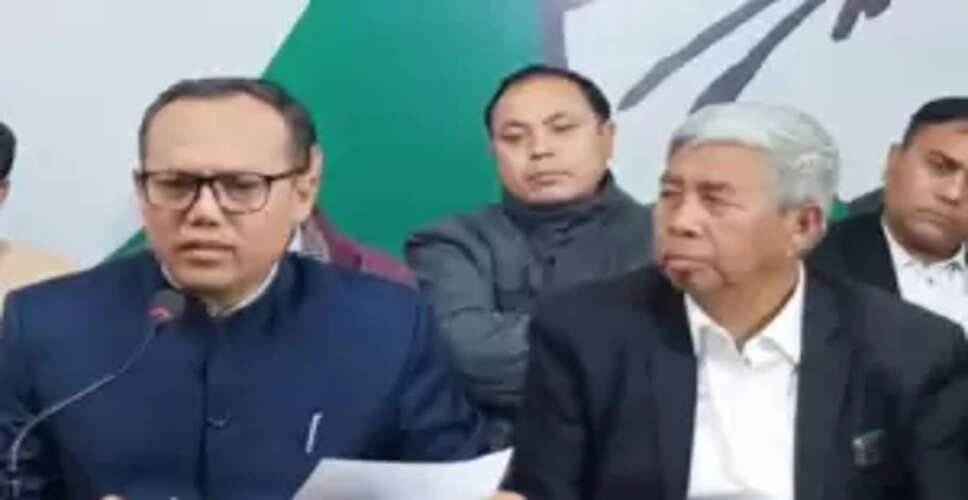
Congress Criticizes NDA for Removing Gandhi's Name
Imphal: The Congress party in Manipur has voiced strong objections against the BJP-led National Democratic Alliance (NDA) government for omitting Mahatma Gandhi's name from the rural employment legislation.
Following the Parliament's approval of the Viksit Bharat, Guarantee for Rozgar and Ajeevika Mission (Gramin) (VB-G RAM G) Bill, 2025, President Droupadi Murmu granted her approval to the bill on Sunday.
Okram Ibobi Singh, a former Chief Minister of Manipur and a prominent Congress figure, condemned the NDA's decision to remove Gandhi's name from the revised rural employment act, which amends the Mahatma Gandhi National Rural Employment Guarantee Act (MGNREGA) of 2005.
Singh, who served as Chief Minister from 2002 to 2017, expressed that this change is a disrespectful act towards the Father of the Nation.
He questioned the reasoning behind substituting Gandhi's name with a different title, arguing that there is no valid justification for excluding the Father of the Nation from a program that embodies his principles.
The former Chief Minister stated that the Congress party vehemently opposes this decision. While he acknowledged that amendments aimed at enhancing welfare, such as increasing the number of guaranteed employment days, could be acceptable, he noted that many aspects of the new legislation remain ambiguous.
Singh also criticized the bill's passage without sufficient debate, asserting that this undermines the parliamentary process. State Congress President Keisham Meghachandra Singh added that the amended Act not only disrespects the Father of the Nation in Parliament but also lacks clarity on several essential provisions.
He highlighted that MGNREGA is a rights-based law that allows villagers to seek legal recourse, a feature that is missing in the new legislation.
By enacting the VB-G RAM G Bill, 2025, the government has effectively issued a 'death certificate' for MGNREGA, which has been a crucial support system for rural India.
Meghachandra Singh expressed the Congress party's deep dissatisfaction and strong opposition to this move, stating that it undermines the foundation of a significant rights-based law that ensures employment, dignity, and livelihood security for millions of rural families. He emphasized that removing Gandhi's name from the scheme is a direct affront to the legacy of the Father of the Nation, whose vision of Sarvodaya and social justice inspired this landmark legislation.
He further argued that the new Act diminishes the rights-based, demand-driven guarantee of employment, thus depriving rural workers of their legally enforceable right to work and making employment contingent on budgetary allocations.
Concerns were raised regarding the altered funding structure, which shifts a larger financial burden onto states, potentially weakening poorer states like Manipur and jeopardizing rural livelihood security.
Additionally, the new framework is seen as undermining federalism by centralizing control and diminishing the autonomy of states and local self-governing bodies.
The Congress party remains committed to supporting rural workers, farmers, and the underprivileged, vowing to resist any efforts to undermine their hard-earned rights.
The press conference featured Congress Working Committee member Gaikhangam Gangmei along with other party legislators and leaders.