
Who Will Lead the Ayodhya Ram Temple? CEO Selection Meeting Set for Wednesday
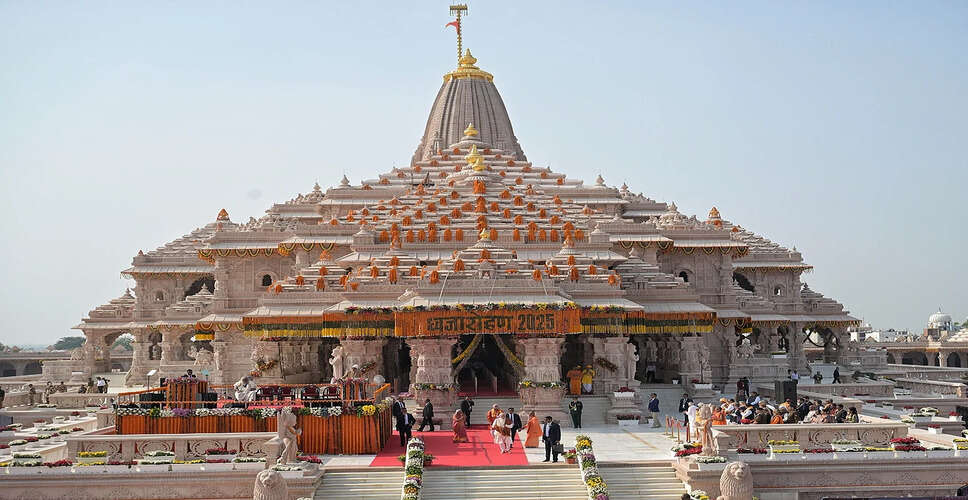

CEO Selection for Ram Temple Trust
In Ayodhya, Uttar Pradesh, a crucial meeting is scheduled for Wednesday to select the inaugural CEO of the Ram temple. This decision will be made by the Shri Ram Janmbhoomi Teerth Kshetra Trust, which is also expected to announce two additional members and a general secretary for the panel, according to insider information.
This meeting follows recent controversies surrounding alleged thefts of donations and the resignation of the temple trust's former general secretary, Champat Rai. It will take place at the residence of the trust's president, Nritya Gopal Das, located in Maniramdas Chhawani.
The selection committee is anticipated to present three candidates to the Shri Ram Janmbhoomi Teerth Kshetra Trust for the CEO position. The committee includes retired Justice Pramod Kohli, retired Lieutenant General Vishnukant Chaturvedi, and expert member Suresh Hawde, who have already arrived in Ayodhya.
The need for new appointments arose due to the passing of trust member Vimalendra Mohan Pratap Mishra, alongside the resignation of Champat Rai and Anil Mishra, which left three positions vacant.
An official announcement regarding the trust's secretary will also be made during the meeting, which is expected to commence at 2 PM on Wednesday.
Jagdish Aafle has been designated as the first secretary of the temple trust. Aafle, hailing from Maharashtra, is affiliated with the Rashtriya Swayamsevak Sangh (RSS) and has been managing the Ram temple construction project.
Residing in Pune, Aafle holds a B.Tech in Electrical Engineering and an M.Tech from IIT Bombay. He has previously worked in India, Europe, and the United States before returning to India post-retirement.
Sources indicate that Aafle was appointed as an honorary project manager for the Ram Mandir construction on the recommendation of the RSS and has been living with his wife at the Shri Ram Janmabhoomi Teerth Kshetra premises in Ayodhya.
There are also indications that Bajrang Lal Bangda, the international general secretary of VHP, may join the trust.
When asked if the new CEO would be announced on Wednesday, the trust's treasurer, Govind Dev Giri, stated, "That is up to the trust to decide. I expect it to happen, but the Board of Trustees will ultimately make that decision."
Giri emphasized the importance of finding an exceptional CEO to manage such a significant and globally recognized temple, noting that the selection panel reviewed around 5,500 applications and interviewed 16 candidates.
Justice (retired) Pramod Kohli, who leads the CEO selection committee, expressed confidence in the candidates chosen, stating they possess a clear vision and understanding of the issues involved.
Regarding the selection process, Justice Kohli assured reporters in Ayodhya that it was conducted transparently and fairly. The trust will ultimately determine which of the three candidates will be appointed as CEO.
The trust's decision was made on July 6, with the selection committee appointed on July 8. Their first meeting occurred on July 11, where initial decisions were made.
Eligibility criteria for the CEO role were established, and applications were accepted until July 18. Justice Kohli reported that 5,585 applications were received during this period.
He described the task of reviewing these applications as extensive, leading to a meeting on July 19 where a Google Form was created to categorize applicants and assign scores based on eligibility criteria.
This form, which totaled 600 marks, was distributed to 3,577 applicants. After further categorization, 108 candidates scored 470 marks or higher, leading to virtual interviews over four days.
From this group, 17 candidates were shortlisted and classified into Grade A, B, and C based on their performance and approach.
Justice Kohli concluded by stating that the panel was formed with individuals who are dedicated, willing to work, and possess a clear vision, aiming to select the most suitable candidate.