
What’s Next for West Bengal's Railway Projects? Union Minister Ashwini Vaishnaw Shares Insights
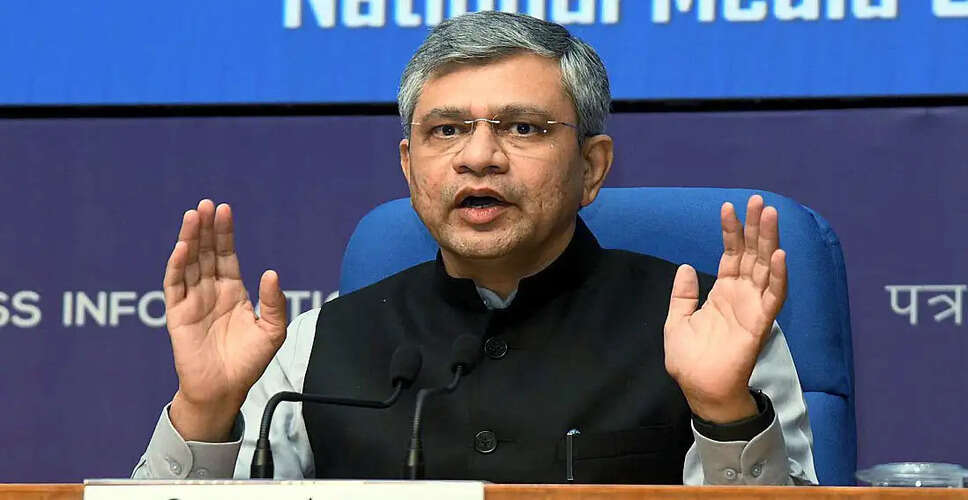

Union Minister's Bold Claims on Railway Development
Kolkata: On Saturday, Union Minister Ashwini Vaishnaw criticized the previous TMC administration for hindering numerous railway and metro initiatives in West Bengal, asserting that progress would now be accelerated due to a shift in the state's governance approach.
In a discussion with Chief Minister Suvendu Adhikari at the Nabanna secretariat, Vaishnaw pointed out that railway projects in the state had encountered numerous obstacles, including permission delays, land disputes, and legal challenges during the TMC's tenure, which he labeled as 'anti-development'.
He announced plans to introduce sixty next-generation trains for the Kolkata Metro within the next five years.
Vaishnaw emphasized that the former government had obstructed all development efforts, contrasting the current allocation of Rs 14,205 crore for railway projects under Prime Minister Narendra Modi's leadership with the mere Rs 4,000 crore allocated during the UPA government.
He noted that since 2014, the pace of metro rail development has significantly increased, with the Kolkata Metro expanding by 45 kilometers in just 12 years after Modi took office, compared to only 28 kilometers over the previous 42 years.
The minister alleged that even basic clearances were delayed under the previous regime, adversely affecting crucial metro and railway projects.
He cited the Chingrighata section of the Kolkata Metro as an example of extensive delays caused by the TMC's legal actions.
Despite planning the Chingrighata Metro project in accordance with Kolkata Police's recommendations, the TMC resorted to legal challenges, hindering commuter benefits, he stated, reiterating his claim that the TMC is 'anti-development'.
Vaishnaw expressed optimism that the situation has improved following the recent formation of the BJP government in the state, which he believes will facilitate the swift execution of pending projects.
With a new political landscape in Bengal, he stated, it is now their duty to realize Prime Minister Modi's vision, and they are committed to working collaboratively.
He expressed confidence that long-standing procedural delays are being addressed, including the resolution of the NoC (no-objection certificate) issues that had previously stalled progress.
The minister assured that the Ministry of Railways would now accelerate infrastructure projects with the state government's support.
He mentioned that the chief minister is enthusiastic and cooperative, having promised full backing for railway initiatives during a recent phone conversation.
Vaishnaw highlighted that railway development in West Bengal would now see rapid implementation, including the redevelopment of stations and the introduction of new services.
He announced plans to reconstruct 102 railway stations and expand premium train services in the state.
The Vande Bharat sleeper train and Amrit Bharat train were first launched in West Bengal, with nine Vande Bharat Express (normal seater) trains and one sleeper train currently operational, along with 13 Amrit Bharat trains.
After arriving in Kolkata, Vaishnaw took a ride on the Kolkata Metro, stating that 60 next-generation trains would be introduced in the next five years, promising significant improvements for Kolkata and its neighboring regions.
He also mentioned proposed high-speed rail corridors connecting Delhi to Varanasi and Varanasi to Siliguri, which would drastically reduce travel times.
These high-speed routes are expected to link Siliguri with New Delhi in just six hours.
Additionally, he discussed the East-West Dedicated Freight Corridor, which will connect Dankuni in West Bengal to Surat in Gujarat, enhancing industrial and trade activities across multiple states.
This dedicated freight corridor is anticipated to greatly benefit West Bengal, Odisha, Chhattisgarh, and Madhya Pradesh, he noted.
Vaishnaw confirmed that 100% railway electrification has been achieved in the state and promised ongoing investments in new trains and infrastructure, stating that new trains, stations, and facilities will be introduced in the near future.
He concluded by mentioning that feedback from legislators has been compiled into a booklet to guide future railway projects in the state.