
What’s Holding Back Baleshwar's Government High School from Progress?
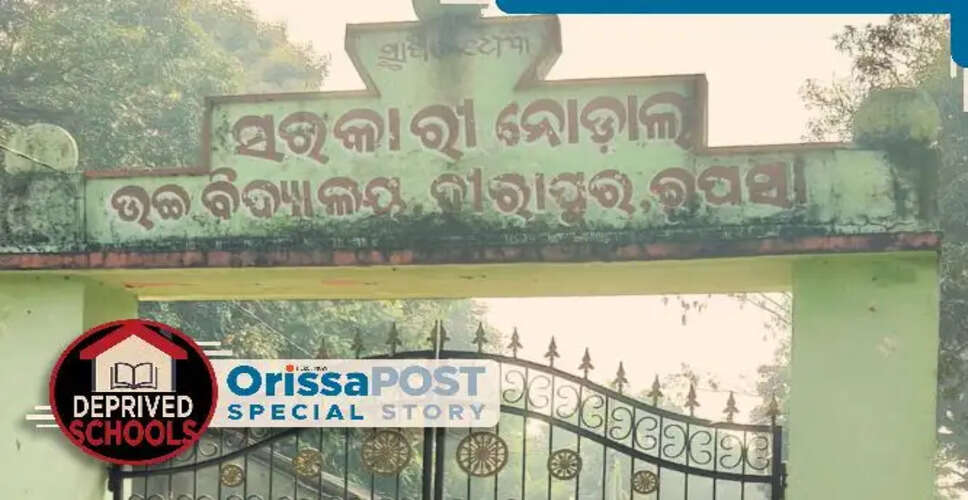

Challenges Faced by Government Nodal High School in Baleshwar
By Banchhanidhi Dey
Baleshwar: Students at a government high school in Baleshwar district are currently learning in a deteriorating brick-and-asbestos building, as the institution struggles with inadequate classrooms and other infrastructural deficiencies, according to local parents and residents.
Established in 1948, the Government Nodal High School in Hirapur, located within the Gadapada panchayat of Basta block, has reportedly seen minimal development over its nearly 80 years of operation, as claimed by the community.
The school is facing a significant shortage of classrooms, compelling students to study in an aging structure with brick walls and an asbestos roof, which parents deem unsafe. Additionally, the campus lacks essential features like boundary walls and a playground, and rainwater leaks into the staff common room during downpours.
Local parents attribute the school's inadequate and chaotic infrastructure to a continuous decline in student enrollment over the years. Initially starting as a primary school, it was upgraded to a high school in 1983.
A UGUP school (covering Classes I to VII) that previously operated on the same premises was merged with the high school on October 1, 2017. The school underwent some renovations under the previous government's 5T initiative, which introduced smart classrooms and a drinking water facility.
Despite these improvements, the classroom shortage remains, forcing students to continue their education in the old, asbestos-roofed building, which residents argue is a safety hazard. Enrollment has significantly decreased in recent years.
At its peak, the school had over 500 students, but current enrollment stands at only 346 across Classes I to X, a drop attributed to the poor conditions. Due to the lack of classrooms, students from Classes I, II, and III are being taught together in one room.
Moreover, students from two additional classes are learning in unsafe conditions within one of three old brick-and-asbestos structures that predate the school's recent renovations. Approximately 30% of the student body belongs to Scheduled Caste and Scheduled Tribe communities, as per school records.
Headmaster Subal Kumar Behera mentioned that two smart classrooms, drinking water facilities, and modern sports equipment were introduced through the 5T initiative. The state government has proposed to recognize the school as a Godavarish School, and a survey for this purpose has been completed, although the final report is still pending. Behera emphasized that efforts are being made to foster a robust academic environment for students.
However, he noted that the school's managing committee has not been established due to a lack of quorum. Gopal Chandra Sahu, president of the alumni association, pointed out that the school has only eight classrooms for ten classes.
Two of these classrooms are situated in abandoned, asbestos-roofed buildings, which he claims disrupts the learning process. Sahu has called for an improved playground to enhance students' physical and mental development, along with better lighting on campus.
Chhotray Murmu, a former student who later served as a finance adviser to the state government, reminisced about his time at the school, recalling how a dedicated headmaster supported him despite his family's financial struggles. He believes that addressing the school's fundamental infrastructure issues could pave the way for a brighter future for its students.
District Education Officer Basant Kumar Nayak confirmed that the school has not yet received approval under the Godavarish School scheme. He stated that once government funding is allocated, steps will be taken to enhance the infrastructure and add more classrooms.