
What’s Happening in the Strait of Hormuz? Iran's Bold Moves Amid Ceasefire Tensions
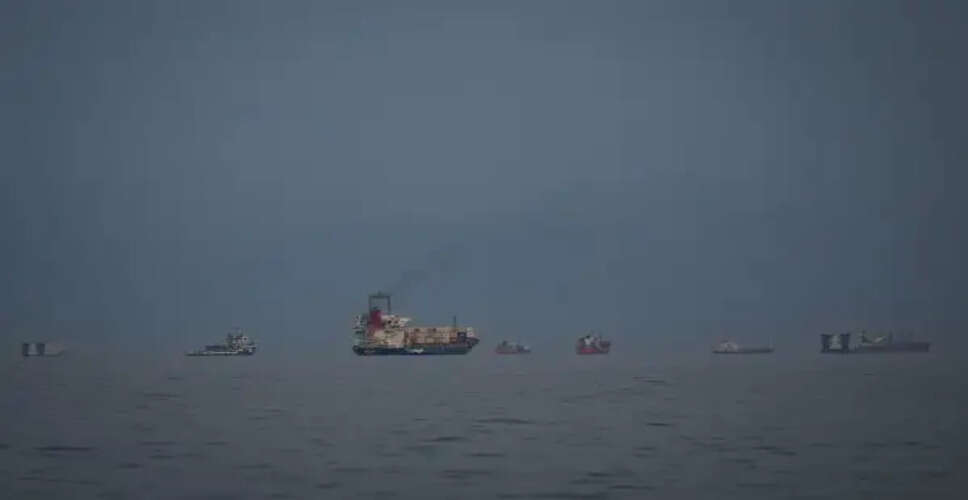

Iran's Strategic Maneuvers in the Strait of Hormuz
Dubai: On Thursday, Iranian semi-official news outlets released a chart indicating that the country's Revolutionary Guard had deployed sea mines in the Strait of Hormuz during the ongoing conflict. This move appears to be a tactic to exert pressure on the United States as a fragile ceasefire, lasting two weeks, hangs in the balance, with further negotiations anticipated in Pakistan.
The ceasefire, which has seen limited success, involves the US, Israel, and Iran, although the three parties have provided conflicting accounts regarding the initial terms.
Israel maintains that the ceasefire does not extend to its military operations against Hezbollah in Lebanon, leading to intensified strikes that Iran claims violate the agreement.
Iran has asserted that it secured control over the Strait of Hormuz, including the right to impose tolls and enrich uranium, while former President Trump contends that the deal necessitates the reopening of the strait and the surrender of Iran's uranium reserves.
The chart, published by ISNA and Tasnim news agencies, which are believed to have ties to the Revolutionary Guard, highlighted a danger zone in Farsi over the Traffic Separation Scheme, the designated route for vessels navigating the strait, a critical passage for 20% of global oil and natural gas trade.
The chart suggested that ships might need to navigate further north, closer to Iran's mainland near Larak Island, a route observed during the conflict. The chart was dated from February 28 to April 9, leaving it unclear whether the Guard had cleared any mines since then.
Oil prices surged above USD 97 per barrel, while Asian stock markets dipped amid skepticism regarding the ceasefire's durability.
Brent crude, the global benchmark, rose by 2.9% to USD 97.46 per barrel, having briefly dipped below USD 92 following the ceasefire announcement. Meanwhile, benchmark US crude increased by 3.7% to USD 97.94 per barrel.
Ship-tracking data from Kpler indicated that only four vessels with active Automatic Identification System trackers passed through the Strait of Hormuz on the first day of the ceasefire.
However, this figure does not account for 'dark fleet' vessels, which operate without their AIS trackers. Many of these ships transport sanctioned Iranian crude oil to the global market.
Trump's Stance on US Military Presence
President Trump reiterated his commitment to maintaining a significant military presence around Iran until a comprehensive agreement is fully adhered to.
His remarks on Truth Social seemed aimed at applying pressure on Iran.
He warned that if compliance is not achieved, which he deemed unlikely, the US would respond with unprecedented military force.
Trump also emphasized that Iran would not be permitted to develop nuclear weapons and assured that the Strait of Hormuz would remain open and secure.
Both the US and Iran claimed victory following the ceasefire agreement, eliciting relief from global leaders. However, subsequent drone and missile attacks targeted Iran and Gulf Arab nations post-announcement.
Escalation of Israeli Attacks in Lebanon
Israel has ramped up its assaults on Hezbollah in Lebanon, striking both commercial and residential areas in Beirut. The violence resulted in at least 182 fatalities on what has been described as the deadliest day of conflict.
Reports from Lebanon's National News Agency indicated that an Israeli strike overnight killed at least seven individuals in southern Lebanon, although the Israeli military did not confirm this attack.
This ongoing violence poses a significant threat to what US Vice President JD Vance referred to as a fragile ceasefire.
Iran's parliamentary speaker criticized the planned discussions, claiming that the US had violated three of Tehran's ten conditions for ending hostilities.
In a social media statement, Mohammad Bagher Qalibaf condemned Israeli strikes on Hezbollah, a drone incursion into Iranian airspace after the ceasefire began, and the US's refusal to acknowledge any Iranian uranium enrichment capabilities in a final agreement.
Iranian Foreign Minister Abbas Araghchi asserted that the cessation of hostilities in Lebanon was part of the ceasefire terms, but Israeli Prime Minister Netanyahu and Trump contended that the truce did not encompass Lebanon.
When the ceasefire was announced, Pakistan's Prime Minister, who acted as a mediator, stated on social media that the agreement applied universally, including Lebanon.
A think tank based in New York cautioned that the ceasefire is precariously close to collapse.
The Soufan Centre noted that Israel's recent strikes on Lebanon heightened the risk of the agreement disintegrating.
Even if Lebanon is technically outside the ceasefire, the scale of Israel's attacks is likely to be perceived as an escalation.
Israel's military actions may be interpreted as an attempt to create a rift between Iran and its allies, as well as a reaction to feeling excluded from the initial ceasefire negotiations.
Upcoming Peace Talks in Pakistan
The White House announced that Vice President JD Vance would lead the US delegation to peace talks in Islamabad, scheduled to commence on Saturday.
Iran's ambassador in Islamabad, Reza Amiri Moghadam, indicated on social media that Iran's negotiating team would arrive in the Pakistani capital on Thursday night, although he later deleted the post without further comment.
His initial message suggested that the discussions would revolve around ten points proposed by Iran.
These points include Iran's uranium enrichment, its control over the Strait of Hormuz, and other contentious issues that have previously stalled negotiations with Trump. The White House has consistently dismissed Iran's ten points as unfounded.