
What’s Brewing in Parliament? Opposition Rallies Against Nari Shakti Vandan Adhiniyam Amendments!

Opposition Voices Concerns Over Nari Shakti Vandan Adhiniyam Amendments
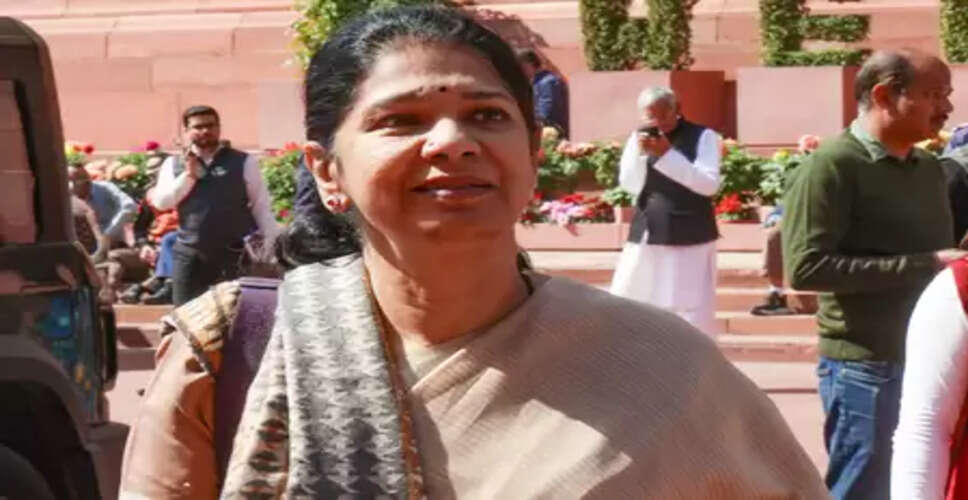
New Delhi: On Thursday, Congress MP Hibi Eden and DMK's Kanimozhi Karunanidhi introduced motions in the Lok Sabha to contest the proposed changes to the Nari Shakti Vandan Adhiniyam.
This action coincides with the commencement of a three-day special session of Parliament, focusing on constitutional amendments related to the Nari Shakti Vandan Adhiniyam's implementation.
The amendments include the Constitution 131st Amendment Bill, 2026; the Union Territories Laws (Amendment) Bill, 2026; and the Delimitation Bill, 2026.
In the midst of the delimitation debate, Telangana's Chief Minister Revanth Reddy is expected to arrive at Parliament later today.
He has addressed a letter to Prime Minister Narendra Modi, expressing concerns that the proposed delimitation could adversely affect southern states.
Reddy has also reached out to the Chief Ministers of Karnataka, Tamil Nadu, Kerala, and Puducherry, urging a united front for equitable representation.
The government plans to present three amendment Bills aimed at implementing the legislation passed in 2023, which mandates a 33% reservation for women in the Lok Sabha and State Assemblies.
Earlier this week, the Central government provided MPs with the text of the Constitution (131 Amendment) Bill, 2026, which seeks to increase Lok Sabha seats to 850, including representatives from States and Union Territories.
The Bill suggests a limit of 815 members elected directly from State constituencies, while allowing for up to 35 members from Union Territories, chosen as per parliamentary law.
Currently, there are 530 Lok Sabha members from States and 20 from Union Territories, although a delimitation commission had previously set the total at 543.
Another significant amendment proposed in the Bill involves redefining 'population,' granting Parliament the authority to determine which census data will be used to expand the number of seats.
To modify clause (3) of Article 81 of the Constitution, the Bill states, "(3) In this article, the expression 'population' means the population as ascertained at such census, as Parliament may by law determine, of which the relevant figures have been published."
Recently, the Union Cabinet approved the Bill aimed at amending the Constitution for the swift implementation of the 33% quota for women in the Lok Sabha and Assemblies, as well as increasing the number of seats in the lower house.
The amendment Bill also seeks to revise Article 82, replacing "Upon the completion of each census, the allocation of seats" with "The allocation of seats."
This proposed amendment aims to decouple the quota's implementation from the 2027 Census, instead relying on the 2011 Census, facilitating its rollout before the 2029 general elections.
Furthermore, the amendment Bill introduces a role for the Delimitation Commission in Article 82, stating that in Article 82 (c) of the Constitution, "for the words 'by such authority and in such manner,' the words 'in such manner and on the basis of such census, by the Delimitation Commission,' shall be substituted."
The Bill also discusses the rotation of reserved seats in the Lok Sabha and Assemblies and includes provisions regarding the duration of women's reservation, subject to parliamentary extension.
Ahead of the special session, various political parties, including the Bharatiya Janata Party, Janata Dal (United), Lok Janshakti Party (Ram Vilas), and Congress, have issued a three-line whip instructing their MPs in both Houses to attend and align with the party's stance during the discussions.