
What’s Brewing in Islamabad? Iran's Foreign Minister Meets Pakistan's Army Chief Amid US-Iran Talks

Iran-Pakistan Meeting Sparks Interest in US-Iran Relations
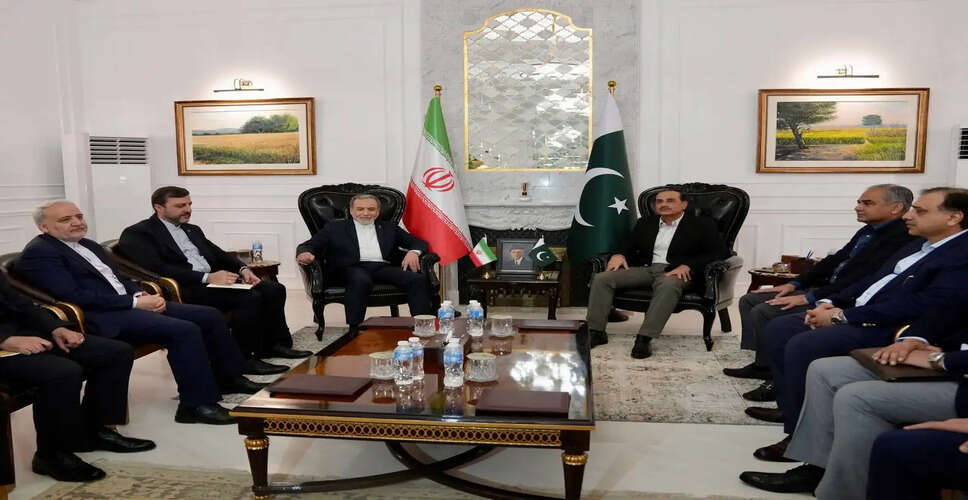
Islamabad: On Saturday, Iranian Foreign Minister Abbas Araghchi held discussions with Pakistan's Army Chief, Field Marshal Asim Munir, as part of Islamabad's ongoing efforts to mediate between the US and Iran.
A brief video shared by the Iranian embassy on social media showed that the meeting also included Iranian Deputy Foreign Minister Kazem Gharibabadi, foreign ministry spokesperson Esmaeil Baghaei, and Ambassador Reza Amiri Moghadam.
From the Pakistani side, Interior Minister Mohsin Naqvi and other officials were present.
The embassy's video caption indicated that Araghchi's meeting with Munir was significant, although no further details about their discussions were disclosed.
According to a senior government official, the Iranian minister engaged in formal talks with Munir, focusing on peace negotiations with the US.
After meeting with Prime Minister Shehbaz Sharif later that day, the Iranian delegation is expected to leave without waiting for the US envoys, indicating that direct talks between Iran and the US are unlikely this week.
Araghchi reportedly communicated specific concerns from Iran to Pakistan, which Islamabad plans to relay to the US delegation upon their arrival. If the US addresses these concerns satisfactorily, a second round of direct talks could be scheduled in Islamabad.
Araghchi arrived in Islamabad late Friday and was welcomed by senior officials, including Munir, Foreign Minister Ishaq Dar, and Interior Minister Mohsin Naqvi.
There remains uncertainty regarding the possibility of direct discussions between Washington and Tehran during this visit.
Earlier, Iranian foreign ministry spokesperson Baqaei stated on social media that no meetings were arranged between Iran and the US.
He confirmed that Iran's observations would be communicated to Pakistan.
Before his trip to Islamabad, Araghchi mentioned that his visit to Islamabad, Muscat, and Moscow was timely, aimed at coordinating closely with partners on bilateral issues and discussing regional developments.
He emphasized that neighboring countries are a priority.
As the Iranian delegation arrived in Islamabad, White House Press Secretary Karoline Leavitt announced that US Special Envoy on the Middle East Steve Witkoff and Jared Kushner, an adviser to President Trump, would be traveling to Pakistan for direct talks with the Iranian representatives.
However, the US team had not yet reached Pakistan.
Meanwhile, Pakistan's Deputy Prime Minister and Foreign Minister Dar expressed optimism on social media about fostering meaningful dialogue between the conflicting parties to enhance regional peace and stability.
According to the Foreign Office, Dar spoke late Friday with Egypt's Foreign Minister Badr Abdelatty, discussing Pakistan's role in facilitating a new round of negotiations between the US and Iran.
The two leaders highlighted the ongoing diplomatic efforts led by Pakistan and stressed the importance of dialogue and sustained engagement to promote peace and stability in the region and beyond.
The initial round of US-Iran discussions on April 11 and 12 did not yield significant results, prompting Pakistan to intensify its diplomatic efforts to ease tensions and revive hopes for further dialogue.
On Tuesday, Trump extended the two-week ceasefire with Iran indefinitely, allowing Tehran additional time to formulate a unified proposal to conclude the conflict, just hours before the ceasefire was set to expire.
The conflict began on February 28 due to US-Israeli strikes.