
What’s at Stake in the Upcoming US Elections? A Deep Dive into the Political Landscape

Critical Elections Loom in the United States
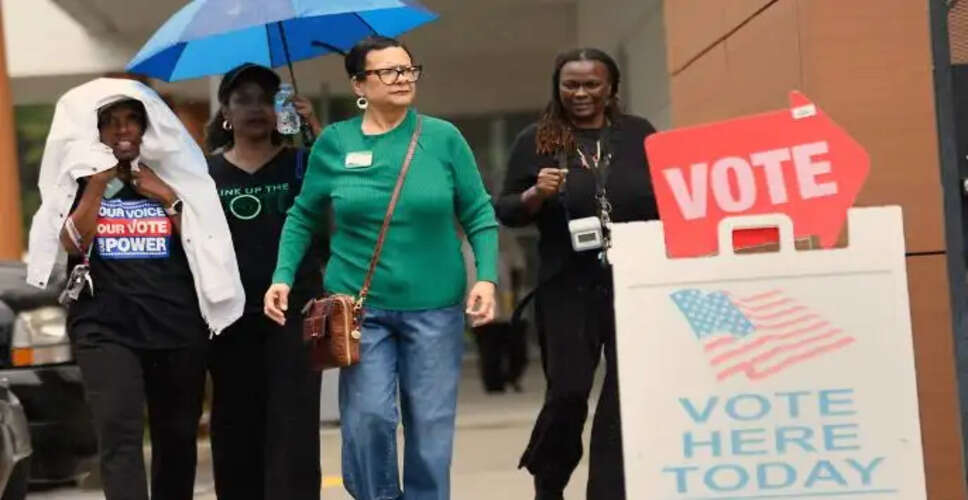
Washington: On Tuesday, Americans will head to the polls for what many consider one of the most pivotal elections in recent history. This election is viewed as a referendum on Donald Trump's presidency, which has been characterized by a lengthy conflict in Iran, escalating inflation, trade disputes, and significant societal divisions.
The outcome will determine if Trump's Republican Party maintains its grip on both the House of Representatives and the Senate, or if, as polls suggest, the Democratic Party will gain control of at least the House, potentially impacting the final two years of Trump's second term.
All 435 House seats and 37 of the 100 Senate seats are up for grabs in this election.
Additionally, gubernatorial elections are taking place in 36 states, including Ohio, where Indian American Vivek Ramaswamy is engaged in a tight race against Democratic nominee Amy Acton.
Several Indian American candidates are also vying for various positions, from Governor to city council roles. Notably, Democrat Nithya Raman, originally from Kerala, is in a competitive battle for the Mayor of Los Angeles, the second-largest city in the nation.
Indian-American representatives Ro Khanna, Ami Bera, Pramila Jayapal, and Suhas Subramanyam are all seeking re-election to the House, while fellow Democrats Pia Dandiya and Amish Shah are aiming to secure their first terms in Congress.
In the lead-up to the election, both parties made their final appeals to voters. Trump chose an unconventional location—the Lincoln Memorial Reflecting Pool—to highlight renovations in Washington, rather than focusing on tax cuts, tariffs, and border security, which have been central themes in his campaign rallies.
The White House reported that Trump conducted a rapid tour of 20 states, primarily Republican strongholds, participating in 30 rallies over the last 32 days. Analysts note that his approval ratings have plummeted, making him a potential liability for Republican candidates.
Should the pre-election predictions hold true and Democrats gain control of Congress, it would enable increased scrutiny of Trump's actions, significantly hindering his ability to advance his agenda. Nevertheless, he would still have the authority to govern through executive orders for the next two years.
Trump has acknowledged the potential limitations on his power but expressed determination not to let Congress impede his progress.
"I guess I’ll become Mr. Veto," Trump remarked during an interview, referring to his presidential authority to reject Congressional actions.
Former President Barack Obama has been actively supporting the Democratic campaign with rallies in key states like Ohio, Michigan, and Georgia, which have visibly unsettled Trump.
"This election is our last, best chance to rein in some of the administration's excesses," Obama stated in Georgia, criticizing Trump for prioritizing White House renovations over pressing issues affecting citizens.
However, Democrats faced an unexpected challenge when Congresswoman Haley Stevens from Michigan switched her allegiance to the Republican Party, breaking ranks with Senate nominee Abdul El-Sayed, who could become the first Muslim elected to the Senate.
The Democratic Party quickly rallied behind El-Sayed, condemning Stevens for endorsing his Republican opponent, Mike Rogers, after losing to El-Sayed in the Senate primary.
The Democrats are aiming to flip seven Senate seats in states including Michigan, Maine, Ohio, Kansas, Texas, Iowa, and Alaska to secure a majority in the Senate. Each of the 50 states has two Senators serving six-year terms, with elections staggered every two years.
House members serve two-year terms.
These mid-term elections are also crucial for Vice President J.D. Vance, who is positioning himself as a potential successor to Trump.
Vance campaigned in New York and Ohio, where Republicans are contesting House and Senate seats, emphasizing Trump's initiatives to eliminate taxes on tips and overtime while labeling Democrats as "lunatics" who disregard American voters.
Approximately 210 million Americans are registered to vote, with California leading at 23.2 million, followed by Texas with 17.4 million and Florida with 13.6 million, collectively representing about 26% of all registered voters.
Conversely, Wyoming (278,468), Vermont (459,455), and Alaska (603,310) have the fewest registered voters.
As of Monday, over 57 million ballots have been cast across 47 states and D.C., compared to just under 44.5 million in 49 states and D.C. during the 2022 elections.