
What’s at Stake in the Strait of Hormuz? France and UK Rally Global Support Amid Tensions
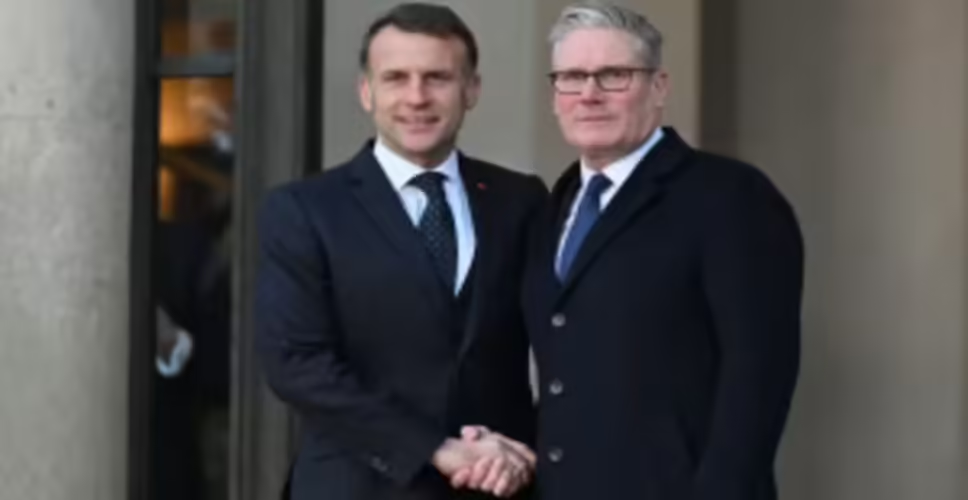

International Leaders Unite to Address Strait of Hormuz Crisis
In Paris, leaders from France and the UK are convening with representatives from numerous nations—excluding the United States—on Friday to advance initiatives aimed at reopening the Strait of Hormuz, a crucial oil passage that has been disrupted due to the ongoing US-Israeli conflict with Iran.
This Paris summit is part of broader efforts by nations that feel sidelined to mitigate the repercussions of a conflict they did not instigate and have not engaged in, yet which has significantly impacted the global economy. Following the onset of hostilities on February 28, Iran effectively closed the strait, which typically facilitates the passage of about 20% of the world's oil.
The US is not involved in the planning of what has been termed the Strait of Hormuz Maritime Freedom of Navigation Initiative. Ahead of the conference, French President Emmanuel Macron emphasized on social media that the mission to secure shipping routes through the strait would be 'strictly defensive,' limited to non-belligerent nations, and activated 'when security conditions permit.'
Macron and UK Prime Minister Keir Starmer have been at the forefront of international efforts to amplify diplomatic and economic pressure on Iran, which Starmer has accused of 'holding the global economy hostage.' The announcement of a retaliatory blockade of Iranian ports by US President Donald Trump has further escalated economic tensions.
'The immediate and unconditional reopening of the Strait is a global obligation, and we must act to restore the free flow of global energy and trade,' Starmer stated prior to the meeting.
Military Strategies Under Discussion
France and the UK have also initiated military planning discussions, reminiscent of the 'coalition of the willing' formed to ensure security for Ukraine in the event of a ceasefire.
French military spokesperson Colonel Guillaume Vernet indicated on Thursday that the mission is still 'under development.'
According to Macron's office, participating nations will contribute 'according to their capabilities,' highlighting that the options for ensuring safe passage through the strait will depend on the security situation following a lasting ceasefire.
'What is crucial is that ship operators have all necessary resources to ensure their vessels are safe while transiting the strait. This may involve intelligence sharing, mine-clearing operations, military escorts, and communication protocols with coastal nations,' an official stated, requesting anonymity as per the French presidency's standard practices.
Sidharth Kaushal, a research fellow specializing in maritime power at the Royal United Services Institute, noted that mine-clearing and establishing a warning system for maritime threats are more likely roles for the coalition than deploying warships to escort commercial tankers through the strait.
'You would need a vast number of vessels for that, which no one possesses,' he remarked.
Iran expert Ellie Geranmayeh, deputy head of the Middle East and North Africa program at the European Council on Foreign Relations, suggested that mine-clearing is an area where European nations and their allies could effectively contribute.
'They would be better suited for this task than the United States, as having US military presence lingering near Iranian shores could lead to miscalculations and escalate military tensions,' she explained.
Global Participation in Ongoing Discussions
The UK has proposed utilizing mine-hunting drones from the ship RFA Lyme Bay for the Hormuz mission.
The ongoing conflict has underscored the diminished capacity of the Royal Navy, which has only deployed one major warship, the destroyer HMS Dragon, to the eastern Mediterranean. In contrast, France, possessing the most formidable military in the European Union, has dispatched its nuclear-powered aircraft carrier to the region, along with a helicopter carrier and several frigates.
Over 40 nations have participated in diplomatic or military discussions led by France and the UK in recent weeks, although fewer are expected to commit military resources.
Macron's office announced that approximately 30 countries will attend Friday's discussions, including representatives from the Middle East and Asia. The specific list of attendees has not been made public. German Chancellor Friedrich Merz and Italian Premier Giorgia Meloni are anticipated to be present in person, while others will join via video link.
This operation is partly a reaction to Trump's criticism of allies for not joining the conflict, asserting that reopening the strait is not America's responsibility. The president has labeled allies as 'cowards,' claimed NATO 'wasn't there when we needed them,' and remarked to Britain, 'You don’t even have a navy.'
'I expect many European nations, and possibly Canada, will want to showcase their ability to provide security independently from the US, demonstrating their capacity for autonomous action,' Kaushal noted.
'However, the question remains as to how many states actually have the spare capacity to contribute to this effort.'