
What to Expect from the Prakriti 2026 Summit on Carbon Markets?
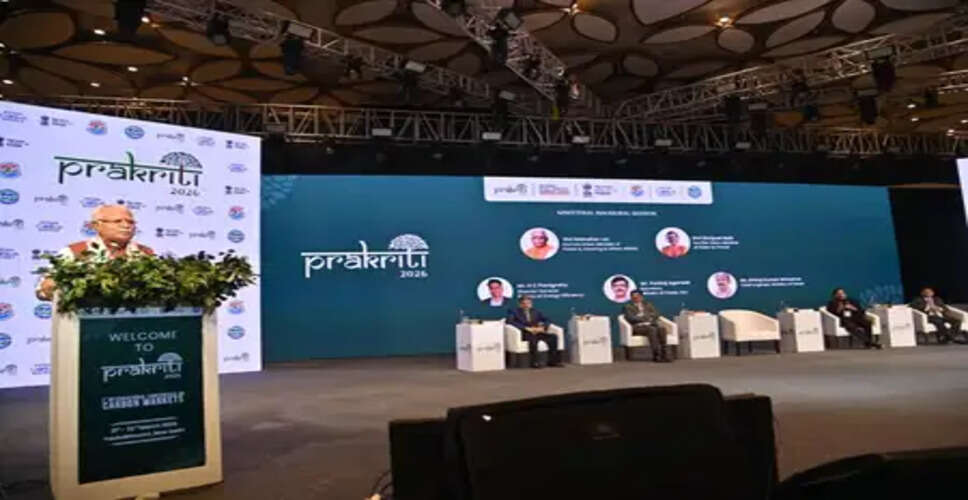
International Conference on Carbon Markets Kicks Off
New Delhi: On Saturday, the Union government launched the International Conference on Carbon Markets, known as Prakriti 2026, which aims to unite policymakers, industry experts, and global leaders to discuss carbon markets and climate initiatives.
This event is organized by the Bureau of Energy Efficiency, under the auspices of the Ministry of Power and the Ministry of Environment, Forest and Climate Change.
As part of the Bharat Electricity Summit 2026, the conference serves as a significant platform for both national and international participants to explore the changing landscape of carbon markets, their impact on climate change mitigation, and the potential for India's sustainable growth.
Additionally, the Indian Carbon Market portal was inaugurated during the event, attended by Union Minister for Power and Housing and Urban Affairs Manohar Lal Khattar, Minister of State for Power Shripad Naik, and other notable figures.
This newly established portal will act as a central hub for managing and executing the Indian carbon market.
During the launch, Minister Khattar emphasized India's proactive stance in fulfilling climate commitments.
He noted that initiatives like the Carbon Credit Trading Scheme, the growth of renewable energy, and energy efficiency programs are crucial in creating a transparent and reliable carbon market framework that will benefit the nation in the long run.
According to Khattar, India has already set up a carbon credit trading system with nine recognized methodologies and over 40 registered entities engaged in projects related to biogas, hydrogen, and forestry.
He encouraged businesses to see carbon markets as more than just compliance obligations, but as a strategic avenue for innovation, investment, and sustainable development.
The two-day conference will include discussions on global carbon markets under the Paris Agreement Crediting Mechanism, compliance frameworks, digital Monitoring, Reporting, and Verification technologies, carbon border policies, and the integration of new sectors like buildings and cooling into India's carbon trading framework.