
What to Expect from ISRO's Groundbreaking NISAR Satellite Launch?
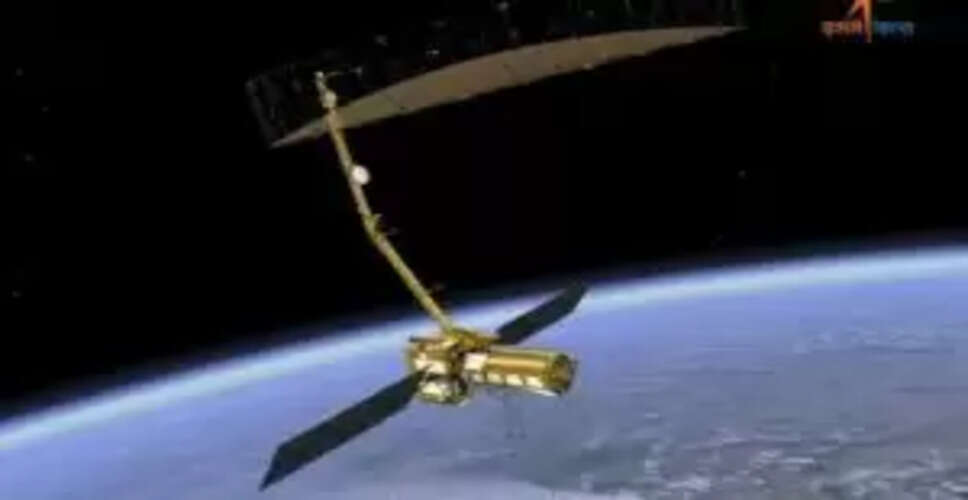
ISRO Set to Launch NISAR Satellite
New Delhi: The Indian Space Research Organisation (ISRO) is preparing to launch the NISAR satellite, a collaborative effort with NASA, on Wednesday. This Earth observation satellite is designed to enhance the management of natural resources and address environmental hazards.
The data collected by the NASA-ISRO Synthetic Aperture Radar (NISAR) will be accessible to global policymakers, aiding in the formulation of effective strategies to combat climate change challenges.
With a budget of USD 1.5 billion, the satellite will be launched aboard the GSLV Mk-II rocket from ISRO's launch site in Sriharikota at 5:40 PM on Wednesday.
"NISAR represents more than just a satellite; it symbolizes India's scientific collaboration with the global community," stated Science and Technology Minister Jitendra Singh.
He emphasized that this mission aligns with Prime Minister Narendra Modi's vision of India as a 'Vishwa Bandhu'—a global partner dedicated to the welfare of humanity.
As the inaugural joint Earth observation initiative between ISRO and NASA, this launch signifies a pivotal moment in Indo-US space collaboration and ISRO's international partnerships.
"NISAR will benefit not only India and the United States but will also deliver essential data to nations worldwide, particularly in disaster management, agriculture, and climate monitoring," Singh added.
A notable aspect of this mission is the commitment to making all data generated by NISAR publicly available within one to two days of collection, and in near real-time during emergencies. This approach aims to democratize data access, supporting global scientific research and decision-making, especially for developing nations lacking similar resources.
The NISAR mission leverages the technological strengths of both NASA and ISRO.
NASA has supplied the L-Band Synthetic Aperture Radar (SAR), a high-rate telecommunications subsystem, GPS receivers, and a 12-meter deployable antenna.
In contrast, ISRO has contributed the S-Band SAR payload, the spacecraft bus to house both payloads, the GSLV-F16 launch vehicle, and all related launch services.
Weighing in at 2,392 kg, the satellite will be positioned in a sun-synchronous orbit, allowing for repeat imaging of the Earth's land and ice surfaces every 12 days.
"This capability will enable ongoing monitoring of ecosystem disturbances and assist in evaluating natural disasters such as earthquakes, tsunamis, volcanic eruptions, and landslides," the minister noted.
The satellite will also track minor shifts in the Earth's crust and surface movements.
Data from NISAR will be instrumental for sea ice classification, ship detection, shoreline monitoring, storm tracking, crop mapping, and soil moisture changes—all critical for governments, researchers, and disaster management agencies.