
What Sparked the Violent Clash Between Jharkhand Police and Job Aspirants?
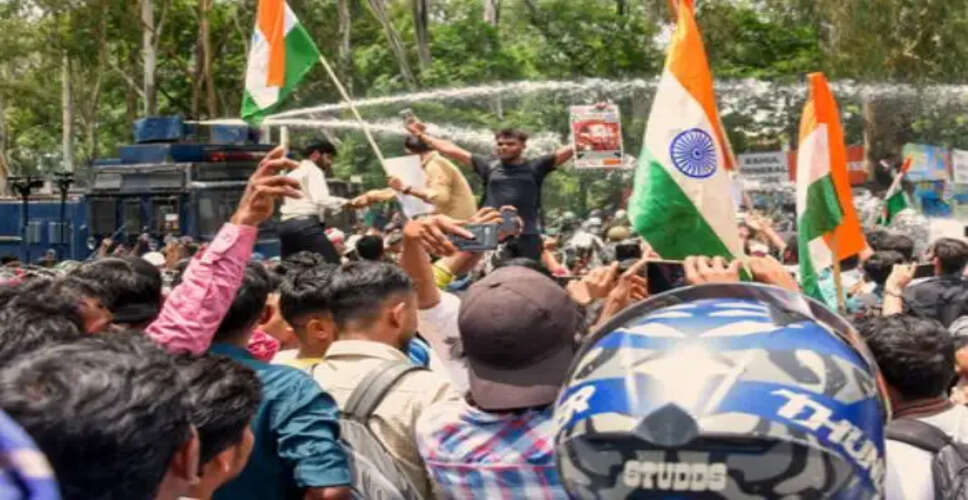

Protests Erupt in Jharkhand Over Recruitment Exam Irregularities
Ranchi: In a dramatic turn of events, police deployed water cannons, tear gas, and batons against job seekers who breached barricades to reach the Jharkhand Assembly, protesting alleged irregularities in recruitment exams.
The Assembly session was adjourned in the afternoon due to the escalating situation.
On Monday, the Jharkhand CID arrested former JPSC chairperson L Khiangte, linked to the ongoing investigation into recruitment exam discrepancies, according to a senior official from the state probe agency.
Khiangte, an IAS officer from the 1988 batch, had taken over as chairperson of the Jharkhand Public Service Commission (JPSC) in February after retiring as chief secretary. He resigned on July 22.
This arrest follows the resignation of all three JPSC members amid widespread protests from aspirants regarding alleged recruitment exam irregularities, bringing the total number of arrests in this case to 20.
During the march towards the Assembly, many protesters reported injuries due to police actions, particularly near Jagannathpur Temple, where the final barricade was located.
Piyush Kumar Soni, a protester, described the police's baton charge as brutal, stating, "We were demonstrating peacefully, yet the government responded with violence. They may injure us physically, but they cannot silence our voices."
He added that numerous female students were hurt, with police striking them on various parts of their bodies.
Vikram Kumar, who traveled from Hazaribag, reported a head injury, questioning the government's actions: "What the Hemant Soren government is doing is unacceptable. We were protesting peacefully; why the police violence?"
The protest coincided with Chief Minister Hemant Soren's 51st birthday, marking the 17th day of demonstrations against recruitment exam irregularities.
Shashank Raj, president of the Bharatiya Janata Yuva Morcha's state unit, condemned the police's actions, labeling the day a dark moment for democracy and highlighting the injuries sustained by many protesters.
He urged the chief minister to be more responsive to the students' demands.
Devendra Nath Mahto, a leader from JLKM who has been fasting for nine days over this issue, participated in the march from an ambulance, holding a portrait of former chief minister Shibu Soren.
Mahto criticized the installation of barbed-wire barricades, expressing that student frustration was growing due to perceived injustices.
"The government is determined to silence us. We will not engage in discussions now," he declared.
Protesters, equipped with tricolors and placards demanding the cancellation of JSSC-CGL exams and a CBI investigation, pushed through multiple barricades despite heavy police presence.
As police deployed water cannons at Jagannathpur Temple, demonstrators initially celebrated by dancing and waving flags. However, tensions escalated when they attempted to advance, leading to a baton charge from law enforcement.
When police could not contain the crowd, they resorted to firing tear gas shells as protesters approached within 200 meters of the Assembly.
"If we can't enter the Assembly, our voices will still be heard. We are not afraid of a government that treats us like traitors. We have been forced to take to the streets," one protester stated.
The JPSC-JSSC Reforms Manch, leading the protests, reported deploying around 500 volunteers to prevent any anti-social elements from infiltrating the march.
Jairam Mahto, a JLKM MLA who joined the march after a fast, questioned the police's restraint against peaceful protesters, emphasizing that they were unarmed.
In response, state minister Sudivya Kumar accused the BJP of politicizing the protests for its own gain.
Speaking to reporters outside the Assembly, he expressed disappointment that job aspirants were protesting despite the government addressing 95% of their demands.
Kumar further claimed that the protests had shifted from a student-led movement to one influenced by the BJP's political agenda.
Heavy security measures were implemented along the 4 km stretch leading to the Assembly, with over 1,500 personnel from various forces deployed to maintain order.
Despite multiple discussions between the government and protesters, a resolution remains elusive.
Protesters noted that the government had only agreed to cancel three of the thirteen exams they sought to annul.
They are demanding significant reforms in the Jharkhand Public Service Commission (JPSC) and Jharkhand Staff Selection Commission (JSSC), alongside the cancellation of several recruitment tests, including the 14th Jharkhand PSC Civil Services Examination, and an independent investigation into the alleged irregularities, either by the CBI or a panel of retired high court judges from outside the state.