
What Led to the Move for Chief Election Commissioner Gyanesh Kumar's Removal?
Opposition Initiates Process for CEC Gyanesh Kumar's Removal
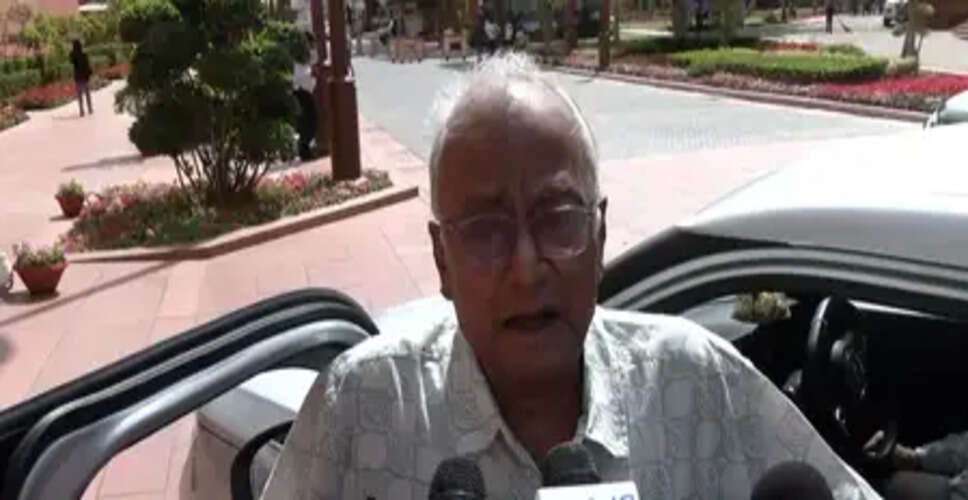
New Delhi: In light of recent developments, the Trinamool Congress has confirmed that notices have been filed in both the Lok Sabha and Rajya Sabha to initiate the removal process for Chief Election Commissioner (CEC) Gyanesh Kumar. MP Saugata Roy stated that these actions are in accordance with legal protocols.
Roy mentioned that the next phase involves forming a committee to investigate the allegations against the CEC.
Addressing the media, he emphasized that the actions taken align with constitutional guidelines and legal frameworks.
"The committee will be established as per legal requirements. Our expectation is that the notice complies with the law, leading to the formation of a committee. The primary accusation is that he has disenfranchised voters by removing numerous names from the electoral rolls, which is entirely unacceptable. Additionally, many Booth Level Officers (BLOs) have tragically lost their lives," Roy stated.
He elaborated on the constitutional process for the removal of the CEC, noting that it mirrors the procedure for dismissing a Supreme Court judge. A minimum of 100 Lok Sabha MPs and 50 Rajya Sabha MPs must endorse the notice. Once the signatures are verified, the Speaker will review them. According to the Judges (Inquiry) Act of 1968, if everything is in order, a three-member committee will be established.
Roy added that this committee will determine the subsequent steps.
"They will decide whether discussions will take place. Thus, the process has officially commenced today," he remarked.
Reports indicate that approximately 130 Lok Sabha MPs and 63 Rajya Sabha MPs have already signed the notice for CEC Gyanesh Kumar's removal.
Concerns have also been raised regarding the Special Intensive Revision (SIR) exercise in West Bengal, with Chief Minister Mamata Banerjee accusing the Election Commission of unjustly removing legitimate voters from the rolls.
The constitutional framework for removing the Chief Election Commissioner is intricate and can only occur on grounds of proven misconduct or incapacity. This process is akin to that for removing a judge from the Supreme Court or High Court.
Article 324(5) of the Constitution stipulates that the CEC cannot be removed from office except in the same manner and for the same reasons as a Supreme Court judge. It also states that the CEC's service conditions cannot be altered to his detriment after appointment.
A motion for removal can be introduced in either House of Parliament but must secure a special majority, which includes a majority of the total membership and a two-thirds majority of those present and voting.
The law governing the appointment of the Chief Election Commissioner ensures that the CEC enjoys protections similar to those of a Supreme Court judge. However, other Election Commissioners can only be removed based on the Chief Election Commissioner's recommendation.
The Judges (Inquiry) Act of 1968 outlines the detailed procedure to follow once such a notice is submitted. If the notice is filed simultaneously in both Houses, a committee will not be formed unless the motion is accepted in both Houses.
Once the motion is accepted, a committee will be jointly constituted by the Lok Sabha Speaker and the Rajya Sabha Chairman.
This committee will consist of the Chief Justice of India (CJI) or a Supreme Court judge, the Chief Justice of a High Court, and a distinguished jurist.
The committee's proceedings will resemble court proceedings, allowing for the examination and cross-examination of witnesses. The Chief Election Commissioner will also have the opportunity to present his defense.
Upon completing its inquiry, the committee will submit its findings to Parliament, after which discussions regarding the removal motion will commence.
For the removal to be enacted, the motion must receive approval from both Houses of Parliament with the necessary special majority.
During the parliamentary debate, the CEC will also have the right to defend himself before the House.
Earlier this week, the Opposition's no-confidence motion against Lok Sabha Speaker Om Birla was dismissed. Birla resumed his duties and asserted that he has always acted impartially.
In his comments, Birla emphasized his commitment to ensuring that every Member of Parliament has the opportunity to speak in the Lok Sabha, stating that while the Leader of Opposition plays a crucial role, he is not "above the House," a remark interpreted as directed at Rahul Gandhi.