
What Led to the Controversial Suspension of Shri Mata Vaishno Devi Medical Institute?
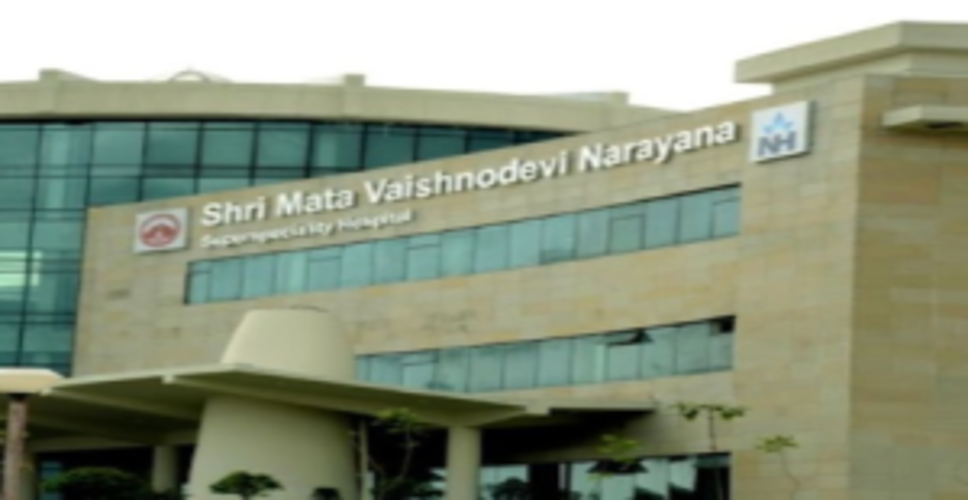
Uncertainty Surrounds Medical Institute in Jammu and Kashmir
Katra/Jammu: The Shri Mata Vaishno Devi Institute of Medical Excellence in Katra, Jammu and Kashmir, is facing a cloud of uncertainty after the National Medical Commission (NMC) unexpectedly revoked its permission letter, halting operations just months after the first academic session began.
The Medical Assessment and Rating Board (MARB) of the NMC cited a failure to meet 'minimum standards' following an unannounced inspection on January 2. However, faculty and students argue that local political influences, rather than genuine academic issues, motivated this decision.
This withdrawal comes on the heels of protests led by the Sangharsh Samiti, a coalition of right-wing groups supported by the BJP, who demanded the cancellation of admissions for 42 Muslim students from Kashmir, along with seven Hindus and one Sikh candidate.
All admitted students had qualified through the National Eligibility-cum-Entrance Test (NEET). The protesting groups have been advocating for the college to discard the current merit list and reserve all seats exclusively for Hindu students.
Despite the NMC's claims of non-compliance, faculty members, who requested anonymity, defended the institution, asserting it is among the best in the Union territory.
A senior faculty member remarked, 'We obtained permission after significant effort and investment. Our infrastructure and faculty are top-notch, and we have everything necessary to operate a medical college.' They questioned the MARB's decision.
The MARB's order, issued on Tuesday evening, stated that all students admitted for the 2025-26 academic year would be relocated to other medical institutions in Jammu and Kashmir as supernumerary seats by the relevant authority of the UT administration.
As of now, there has been no official communication from the medical college regarding this matter.
Faculty members expressed that the NMC's findings could be contested in detail, emphasizing that the circumstances surrounding the inspection and subsequent decision are well-known, especially given the unrest in the Jammu region.
Highlighting the human impact of this decision, another faculty member noted that approximately 150 individuals left their jobs in both government and private sectors to join the institution, leaving them anxious about their future.
The faculty also criticized the 'unusual haste' of the NMC's decision, arguing that standard administrative procedures were overlooked, as the institute should have received a show-cause notice first, allowing for a formal response and a chance for rectification.
'The established procedure involves responding to a show-cause notice,' a faculty member explained, adding that if the response is found lacking, the matter typically escalates to the Union health ministry for a final hearing before such a drastic action as derecognition is taken.
The faculty member expressed that, as one of the leading institutes in a developmental phase, the NMC's action is a significant setback for the medical college.
'We believe that the NMC's order does not signify the permanent closure of the institute. We are optimistic that the shrine board will devise a plan to protect the staff and the institution's future,' they stated.
Regarding the possibility of reapplying for the permission letter, the faculty member noted that it may not resolve the underlying issues.
'We can submit a fresh application in response to the notification at any time, but it may not be beneficial since the situation could remain unchanged. What is essential is to prevent this situation from arising again and to implement long-term solutions for the smooth operation of the institute,' they added.
Outlining potential alternatives, they mentioned, 'We have two options. One is for the chief minister to issue a no-objection certificate, allowing admissions through Central counselling, enabling students from across the country to enroll based solely on merit, similar to Sharda University in Uttar Pradesh.'
'The second option is to pursue deemed university status. We are already operating three of the five required faculties – medicine, nursing, and social sciences (Gurukul). We need two additional faculties, such as allied health sciences and public health specialization. This can be achieved under the leadership of the shrine board chairman and may take about a year,' they explained.
'The college has the potential to become one of the premier medical colleges in the country, given its infrastructure and facilities. I have visited numerous medical colleges in India and abroad, and this one has superior infrastructure and faculty compared to others in J-K,' another faculty member remarked.
Students have also voiced their distress over the withdrawal of permission, calling the decision 'heartbreaking.'
'We gained admission through a competitive exam, and the NMC's decision has shocked us because we did not anticipate such a development at the start of our course,' said Bilquis, a student from Budgam.
She added that they experienced no issues or discrimination based on religion on campus.
Mahit Srivastava, a student from Udhampur, described the decision as 'very unfortunate,' stating, 'It serves as an example of 'axing one's own feet.'
'I was confident that the college would build a strong reputation in the coming years. Suspending the course is a significant mistake and a major loss for us and our region. We are uncertain about where we will be relocated. We are confused and lack information,' he expressed.
Another student emphasized that they were admitted solely based on merit.
'The facilities were exceptional, which is indisputable. We faced no issues on campus despite the protests outside by right-wing groups. We lived in harmony. This decision has left us heartbroken,' the student lamented.