
What Key Agreements Will Modi and Nepal's PM Discuss During Their Meeting?

Strengthening India-Nepal Relations
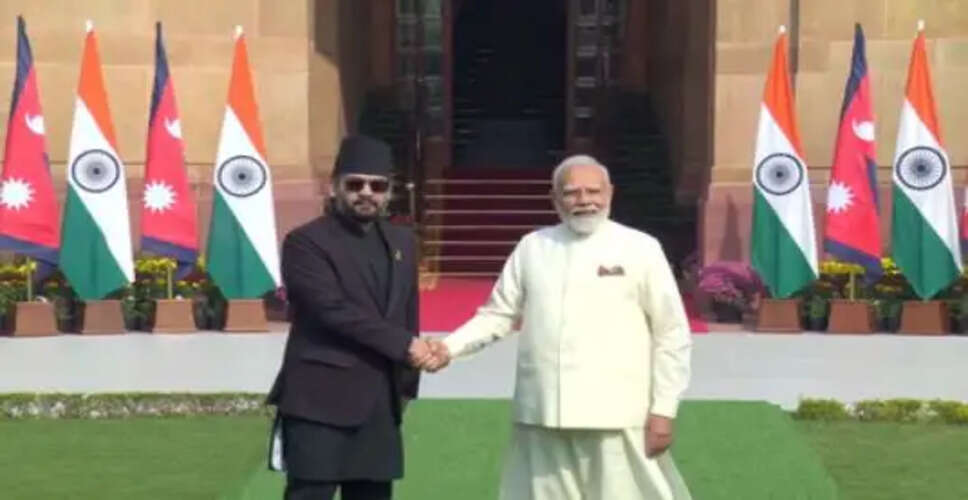
Prime Minister Narendra Modi welcomed Nepal's Prime Minister Balendra Shah at Hyderabad House on Monday, where they engaged in discussions aimed at enhancing collaboration across various sectors.
The leaders reviewed the comprehensive scope of India-Nepal relations and exchanged insights on regional and global matters of shared interest.
They also planned to virtually launch the Saryu-Kamala Express from New Delhi.
After their discussions, both leaders will hold a joint press conference, and Modi will host a formal luncheon in honor of Shah and his delegation.
Earlier that day, Shah received a ceremonial welcome at Rashtrapati Bhavan, where Modi greeted him warmly upon his arrival.
Shah arrived in New Delhi on Sunday for a two-day official visit to India, invited by Modi. He was welcomed at the airport by Union Minister of State for Commerce and Industry, Jitin Prasada.
During his visit, Shah is also scheduled to meet with President Droupadi Murmu.
Accompanying the Nepali Prime Minister is a 35-member delegation, including Finance Minister Swarnim Wagle, Foreign Minister Shishir Khanal, Chief Advisor to the Prime Minister Kumar Byanjankar, and other senior officials.
A separate group of 52 business representatives will also join the visit at their own expense.
The discussions are anticipated to address topics such as post-flood reconstruction aid, energy, trade, connectivity, and broader cooperation between the two nations.
Both sides are expected to unveil a Joint Vision Document titled “Samriddha Nepal, Samunnat Bharat” (Prosperous Nepal, Developed India), which will outline long-term goals and specific targets for collaboration.
Additionally, several completed projects related to connectivity and energy cooperation will be inaugurated, and new projects will have their foundation stones laid during this visit.
Nepal's Foreign Ministry indicated that the talks will emphasize enhancing economic cooperation in trade, transportation, investment, energy, connectivity networks, and infrastructure development.
Furthermore, both nations will exchange memorandums of understanding (MoUs) to foster cooperation in education, health, agriculture, sports, disaster management, and human resource development.