
What Happened to the Graffiti at Jantar Mantar? A Symbol of Protest Erased!
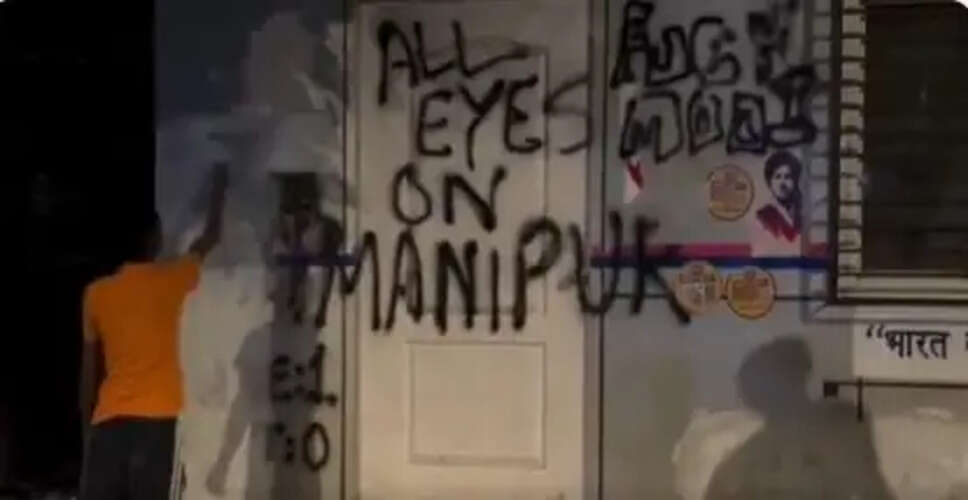

Graffiti Erased at Jantar Mantar
New Delhi: On Sunday, municipal workers took action to cover the graffiti that adorned the walls surrounding Jantar Mantar, effectively removing the visual representation of the student-led protests that led to the resignation of Union Education Minister Dharmendra Pradhan.
As of Saturday evening, the white boundary wall of the Imperial Hotel along Tolstoy Marg had transformed from a mere structure in Lutyens' Delhi into a powerful canvas of dissent.
The walls in the vicinity of Jantar Mantar, along with gates and tree trunks, were plastered with layers of graffiti, slogans, sketches, and signatures, creating a vibrant display of a generation's frustration with the NDA government's perceived shortcomings.
This graffiti captured the essence of a protest largely fueled by youth—irreverent, sardonic, and often unfiltered by traditional political rhetoric.
Messages ranged from critiques of the media to calls for revolution, alongside tributes to B R Ambedkar and pointed criticisms of government officials, interspersed with doodles and memes.
In vivid colors, the graffiti conveyed a mix of political and personal sentiments.
Phrases like 'Democracy is premium' and 'R'evol'ution' appeared next to the anti-fascist anthem Bella Ciao, reflecting Gen Z's attitude of holding grudges, along with the Gandhian phrase, 'Hamla chahe jaisa bhi ho, haanth hamaara nahin uthega.'
Many messages specifically targeted the RSS, calling for its ban, while others expressed gratitude to Lok Sabha Leader of Opposition Rahul Gandhi for voicing the concerns of student protesters.
While some slogans seemed meticulously crafted, the majority appeared hastily written, indicating a spontaneous release of emotions.
The walls were also filled with numerous handwritten notes, names, and social media handles from protesters eager to leave their legacy on the movement.
However, by Sunday, most of this expression had been wiped away as the New Delhi Municipal Council (NDMC) initiated a clean-up operation around Jantar Mantar, deploying over 100 sanitation workers along with heavy machinery to remove nearly 60 metric tonnes of debris left after the protests.
Officials reported that approximately 52 metric tonnes of waste had been cleared by Sunday afternoon.
Roads were cleaned using pressure-jetting machines, while walls with protest slogans were repainted, and damaged footpaths and curbstones were repaired to restore the area following the dispersal of protesters, according to an NDMC official.