
What Does the Deployment of Russia's Oreshnik Missiles in Belarus Mean for Ukraine?
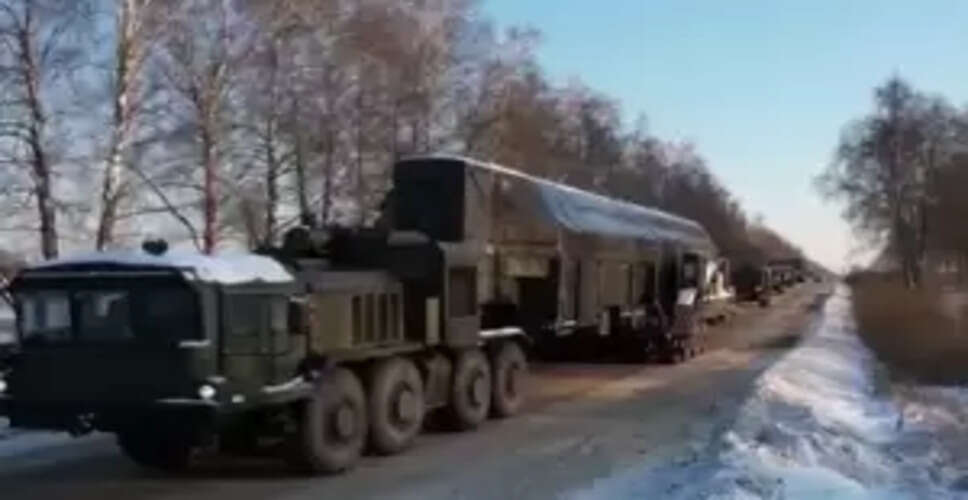
Russia's Oreshnik Missile System Now Active in Belarus
Moscow: The Russian Defence Ministry announced on Tuesday that the Oreshnik missile system, capable of carrying nuclear warheads, has been officially deployed in Belarus. This development comes as the United States intensifies its efforts to negotiate an end to the ongoing conflict in Ukraine, which has persisted for nearly four years.
A video released by the ministry showcased mobile intermediate-range ballistic missile systems conducting training exercises in a forested area.
This announcement follows remarks from Belarusian President Alexander Lukashenko, who indicated earlier this month that the Oreshnik systems had arrived in Belarus, with plans to station up to ten of these missile systems in the country.
Russian President Vladimir Putin had previously stated that the Oreshnik would be operational by the end of the year during a meeting with senior military officials, where he emphasized that Russia would aim to expand its territorial gains in Ukraine if its demands in peace negotiations were not met.
This announcement is particularly significant as peace talks between Russia and Ukraine are at a crucial juncture. Recently, US President Donald Trump hosted Ukrainian President Volodymyr Zelenskyy at his resort in Florida, claiming that both nations were 'closer than ever' to reaching a peace agreement.
Despite these claims, substantial disagreements remain between Moscow and Kyiv, particularly regarding the withdrawal of forces and the status of the Zaporizhzhia nuclear power plant, which is under Russian occupation and ranks among the largest in the world. Trump acknowledged that the ongoing negotiations, led by the US, could still fall apart.
Putin has attempted to project strength in negotiations, especially as Ukrainian forces struggle against the larger Russian military.
The Oreshnik missile, named after the hazelnut tree, was first tested in November 2024, targeting a Ukrainian factory with a conventionally armed variant.
Putin has boasted that the Oreshnik's multiple warheads can descend at speeds reaching Mach 10, making them nearly impossible to intercept, and that a conventional strike involving several of these missiles could be as catastrophic as a nuclear attack.
The Russian leader has also warned Western nations that the Oreshnik could be used against Kyiv's allies that have facilitated strikes on Russian territory using longer-range missiles.
According to the Belarusian Defence Ministry, the Oreshnik has a striking range of up to 5,000 kilometers.
Russian state media claimed that the missile could reach an airbase in Poland in just 11 minutes and NATO headquarters in Brussels within 17 minutes, with no way to determine whether it carries a nuclear or conventional warhead until impact.
Intermediate-range missiles are defined as those capable of flying between 500 and 5,500 kilometers, a category banned under a treaty that the US and Russia abandoned in 2019.
Russia has previously stationed tactical nuclear weapons in Belarus, which it used as a launch point for its full-scale invasion of Ukraine in February 2022. Lukashenko has stated that Belarus possesses several dozen Russian tactical nuclear weapons.
During a security agreement signing with Lukashenko in December 2024, Putin indicated that while Russia would control the Oreshniks, Belarus would have the authority to select targets. He noted that if the missiles were aimed at targets closer to Belarus, they could carry a significantly heavier payload.
In 2024, the Kremlin updated its nuclear doctrine, asserting that any conventional attack on Russia supported by a nuclear power would be treated as a joint assault on the nation.
This warning appears aimed at deterring the West from permitting Ukraine to strike Russia with longer-range weaponry and significantly lowers the threshold for the potential use of Russia's nuclear arsenal.
The revised doctrine also extends Russia's nuclear umbrella to Belarus.
Lukashenko, who has ruled Belarus for over three decades with an authoritarian grip, has faced numerous sanctions from the West due to human rights violations and for allowing Russia to utilize Belarusian territory for its invasion of Ukraine.
Belarusian opposition leader Sviatlana Tsikhanouskaya has criticized the deployment of the Oreshnik, arguing that it further entrenches Belarus's military and political reliance on Russia.