
What Did Union Education Minister Pralhad Joshi Propose at the BRICS Education Ministers' Meeting?

Collaboration Among BRICS Nations for Educational Advancement
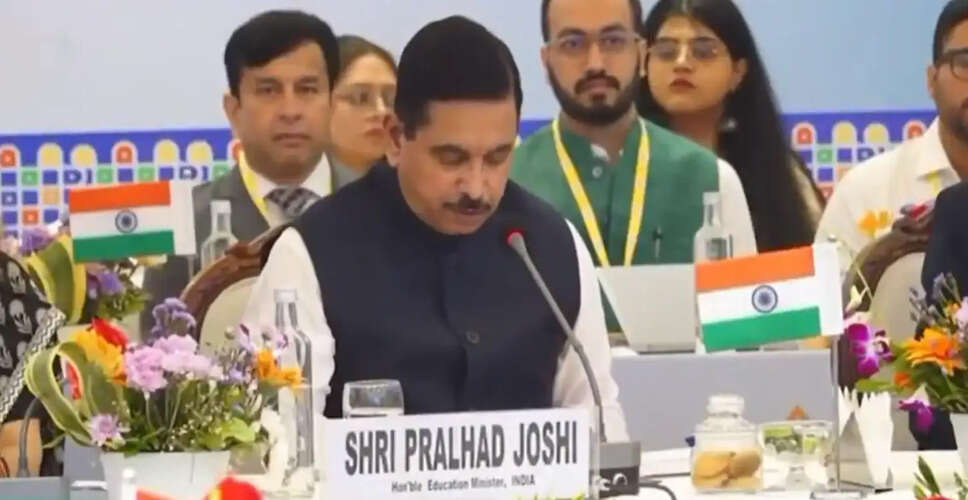
Bhubaneswar: On Friday, Union Education Minister Pralhad Joshi urged BRICS nations to unite in tackling shared challenges within the education sector, emphasizing that issues like resilience, innovation, and sustainability require collective action rather than isolated efforts.
During the 13th BRICS Education Ministers' Meeting, which concluded with the endorsement of a five-point declaration, Joshi highlighted that India's leadership was driven by the principles of resilience, innovation, cooperation, and sustainability.
Reiterating India's dedication to a 'people-centric' and 'humanity-first' approach in BRICS collaboration, he stressed the necessity of innovation to ensure that educational frameworks adapt to the evolving aspirations of future generations.
Joshi elaborated on the significance of resilience, stating that educational systems must be robust enough to endure disruptions from pandemics, economic fluctuations, climate challenges, and rapid technological advancements.
He pointed out that education systems must not remain stagnant, as the world is undergoing swift changes.
According to him, 'Education systems must evolve to align with the aspirations of each new generation and equip our youth for opportunities that may not yet exist.'
He underscored the importance of collaboration, asserting that cooperation and sustainability are vital for effectively addressing common challenges.
'While more of us can tackle these issues, none can do so alone. The knowledge we generate, the technology we create, and the institutions we fortify must benefit not just the current generation but also those to come,' he remarked.
Joshi emphasized that educational frameworks should prepare youth for new opportunities while remaining grounded in human values.
He stated that learners, educators, researchers, and young individuals should be central to policy-making and international collaboration.
According to him, education is the cornerstone of inclusive growth and shared prosperity, and the adopted declaration reflects the collective commitment of BRICS nations to enhance cooperation in five key areas. He also highlighted the importance of safeguarding and promoting traditional and indigenous knowledge systems.
He noted that innovation and heritage can complement each other.
'The rich civilizational traditions of BRICS countries offer a unique chance to preserve traditional knowledge, study it thoroughly, and pass its value to future generations,' the minister added.
The meeting saw participation from ministers, senior officials, and delegates from BRICS member states, including Brazil, Russia, China, South Africa, Indonesia, Iran, Ethiopia, and the UAE, all aimed at fostering cooperation within the BRICS Education Track.
The five priority areas adopted during the meeting include enhancing Early Childhood Care and Education (ECCE) and Foundational Literacy and Numeracy (FLN).
'It was agreed to promote universal and inclusive access to quality ECCE, bolster school readiness, and advocate for age-appropriate digital solutions for early learning,' an official stated.
The second consensus among BRICS nations was to strengthen collaboration in skill development and Technical and Vocational Education and Training (TVET).
The declaration also recognized India's initiative to conduct an International Skill Gap Study, inviting participation from interested BRICS members on a voluntary basis.
Additionally, the meeting adopted a proposal to enhance research, innovation, and start-up ecosystems.
Under this agreement, BRICS nations will promote joint research, encourage the ethical and human-centered use of Artificial Intelligence in education, strengthen innovation-driven entrepreneurship, and deepen collaboration among higher education institutions, researchers, and start-up ecosystems.
The declaration also agreed to advance mutual recognition of qualifications (MRQ) and enhance capacity building for academic leadership and institutional development.
Prior to the ministerial meeting, the Ministry of Education hosted the 3rd BRICS senior officials' meeting under India's BRICS Chairship on August 5, 2026.
An official statement indicated that India will continue to host BRICS Ministerial Meetings across various sectors during its Chairship, culminating in the 18th BRICS Summit scheduled for September 12 and 13, 2026, in New Delhi.