
West Bengal Election Commission Halts Hearings for Unmapped Voters Amid Roll Revision
Election Commission's Directive on Voter Hearings
The Election Commission has instructed the cessation of personal hearings for voters in West Bengal identified as 'unmapped' during the current special intensive revision of electoral rolls. This decision affects those whose names or ancestral ties were included in the 2002 voter list, as reported by a local news source on Sunday.
This directive was issued on Saturday after state officials verified that numerous voters or their descendants, previously labeled as 'unmapped' in the central software of the poll panel, were indeed present in the area.
The draft electoral rolls for the state were released on December 16, revealing that over 58 lakh voters had been removed due to being marked as deceased, relocated, or absent. Additionally, 31 lakh voters were categorized as 'unmapped', meaning they were not found in the 2002 rolls during the last special intensive revision.
In a communication to district election officers, the additional chief electoral officer of West Bengal noted that many voters were marked as 'unmapped' because the data from the 2002 electoral rolls had not been completely converted into a plain text format.
Consequently, the linkage could not be retrieved in the booth-level officer (BLO) application for numerous electors, as stated by the additional chief electoral officer.
The letter further mentioned that the state chief electoral officer had requested the poll panel to permit booth-level officers, electoral registration officers, and additional electoral registration officers to directly upload relevant sections of the hard copy of the 2002 voter roll for mapping purposes.
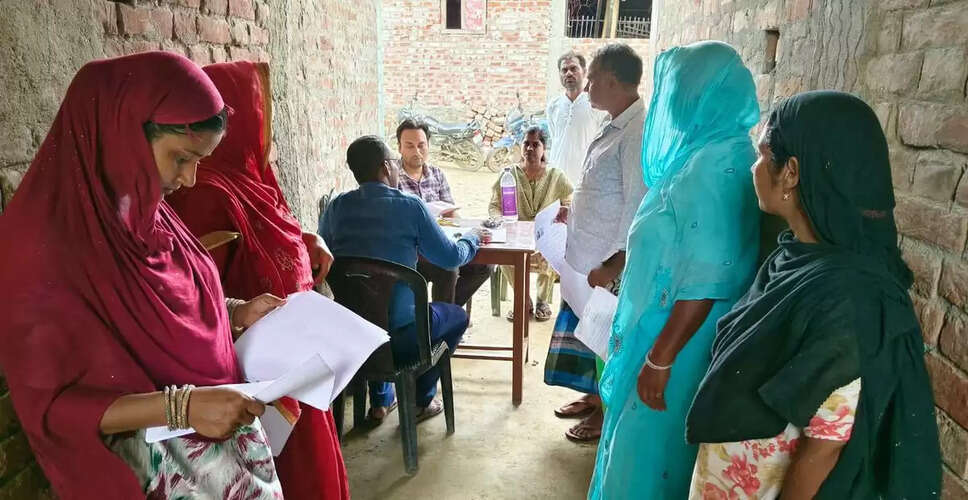
Following the publication of the draft rolls, the poll panel issued notices to unmapped electors, asking them to verify their eligibility through personal hearings.
However, the additional chief electoral officer indicated in the letter that these electors might not be summoned for hearings despite receiving notices.
Instead, the notices could be retained by the electoral registration officer or assistant electoral registration officer. The letter suggested that BLOs should be dispatched to the field to take photographs with such electors, which could then be uploaded.
It was also noted that if discrepancies arise later with the hard copy of the 2002 electoral roll by the electoral registration officer or assistant electoral registration officer, or upon receiving complaints, the affected electors may be called for hearings after serving notices.
This announcement coincided with objections raised by the West Bengal Civil Service Executive Officers’ Association regarding what they termed as 'suo motu system-driven deletion' of voters from the draft electoral rolls.
The association contended that the mass deletion of a significant number of electors could violate the rights of eligible voters who were unable to participate in the enumeration process.
West Bengal is anticipated to conduct Assembly elections in the first half of 2026.
In addition to West Bengal, the special intensive revision of electoral rolls is also taking place in 11 other states and Union Territories.
In Bihar, where the revision was finalized ahead of the Assembly polls scheduled for November, approximately 47 lakh voters were excluded from the final electoral roll published on September 30.
Concerns were raised in Bihar regarding the potential removal of eligible voters from the rolls, leading several petitioners to approach the Supreme Court.