
West Bengal Assembly Elections: High Voter Turnout Amid Tensions and Allegations

Kolkata Sees Intense Political Rivalry
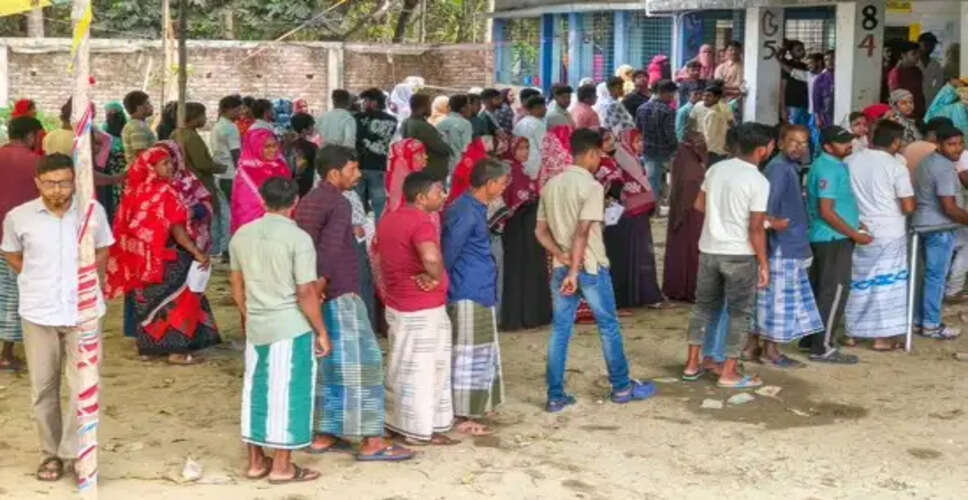
In Kolkata, over 78% of the 3.21 crore registered voters participated in the second and final phase of the West Bengal Assembly elections by 3 PM on Wednesday, despite reports of sporadic violence in various regions.
Tensions escalated in the Bhabanipur constituency as Chief Minister Mamata Banerjee and BJP's Suvendu Adhikari exchanged barbs in close proximity at the polling booth.
The election day unfolded with familiar scenes across Bengal, including long lines at polling stations, minor altercations, and ongoing political disputes.
The impact of anti-incumbency sentiments and revisions to the voter list could potentially reshape the political landscape at Nabanna, the state secretariat.
While the first phase on April 23 tested the BJP's grip on northern Bengal, the final phase is viewed as a critical challenge for the party as it attempts to penetrate the TMC's stronghold in southern Bengal.
Out of the 142 seats contested in this phase, the ruling TMC had secured 123 in the previous election, leaving only 18 for the BJP and one for the ISF.
For the BJP, breaking through the Kolkata, Howrah, Hooghly, Nadia, North and South 24 Parganas, and Purba Bardhaman regions is essential for any realistic chance at forming a government.
This political reality heightened the significance of the 78.68% voter turnout recorded by 3 PM in this phase.
As voting continued until 6 PM, analysts suggested that the final turnout might rival or even surpass the impressive 93.19% seen in the first phase.
The turnout figures were nearly identical to those from the first phase, which reported over 78.77% participation by 3 PM.
Purba Bardhaman led with the highest turnout at 83.11%, followed by Hooghly at 80.77% and Nadia at 79.79%.
Howrah recorded 77.73%, North 24 Parganas 77.39%, while Kolkata North and South saw turnouts of 78% and 75.38%, respectively. South 24 Parganas, a hotspot for key contests, had a turnout of 76.75%.
The TMC interpreted the turnout as evidence of its welfare initiatives and Mamata Banerjee's enduring influence in southern Bengal.
In contrast, the BJP viewed it as an indication of public discontent regarding alleged corruption, recruitment scandals, law-and-order issues, and anti-incumbency sentiments mobilizing against the ruling party.
The focal point of the contest is Bhabanipur, where Adhikari is challenging the TMC leader, transforming her stronghold into a battleground for the state's most significant prestige contest. This election is perceived as a rematch of the Nandigram contest, where Adhikari triumphed over Banerjee in 2021.
Breaking from tradition, Banerjee cast her vote early, around 8 AM, visiting areas like Chetla, Padmapukur, and Chakraberia following reports of intimidation against local TMC leaders.
While she sat outside a polling booth with a heavy presence of central forces, Adhikari arrived and asserted, 'I will not tolerate any hooliganism.'
Banerjee accused the BJP of attempting to 'rig' the election through the use of central forces and election officials. 'The BJP aims to manipulate this election. Elections in Bengal are typically peaceful. Is there a reign of terror here?' she questioned, alleging that CRPF personnel had visited TMC leaders' homes late Tuesday night, instilling fear.
Adhikari dismissed her claims as 'frustration,' asserting that Banerjee had come to realize that 'not a single vote was coming her way.'
Tensions flared again in Kalighat when Adhikari visited another booth, prompting TMC supporters to chant slogans against him. Police intervened with a lathi-charge to disperse the crowd as BJP supporters retaliated with counter-slogans.
Violence and disruptions were reported across various districts beyond Bhabanipur.
In Chapra, Nadia, a BJP polling agent was allegedly attacked during a mock poll, while in Shantipur, a BJP camp office was vandalized. In Bhangar, the ISF claimed its polling agents were barred from entering booths.
An EVM malfunction in Bally delayed voting, leading central forces to use a lathi-charge to manage the agitated voters.
In Kolkata's Entally, BJP candidate Priyanka Tibrewal alleged that TMC polling agents attempted to assault her after she raised concerns about overcrowding and lack of voter privacy inside a booth.
In Panihati, BJP candidate Ratna Debnath, mother of a victim from the R G Kar case, faced protests, while her party colleague in Basanti, Bikash Sardar, claimed that '200 to 250 TMC goons' attacked his vehicle and assaulted his driver.
The TMC denied or did not respond to most of the allegations.
However, the broader political contest remains focused on the Special Intensive Revision of electoral rolls.
In southern Bengal, millions of names were removed from the voter list before the elections—over 12.6 lakh in North 24 Parganas, 10.91 lakh in South 24 Parganas, nearly 6.97 lakh in Kolkata, and around six lakh in Howrah.
In at least 25 constituencies, the number of deleted names surpassed previous victory margins. This situation has turned turnout statistics into a political debate over who was counted and who was not.
The BJP has framed the SIR as a necessary correction of voter lists, while the TMC has portrayed it as a targeted disenfranchisement affecting minority and migrant-heavy areas. Political analysts suggest that the contest may continue long after the votes are counted, especially in districts where victory margins are narrower than the number of deleted names.