
Vijay's Party Secures Majority in Tamil Nadu Assembly Elections
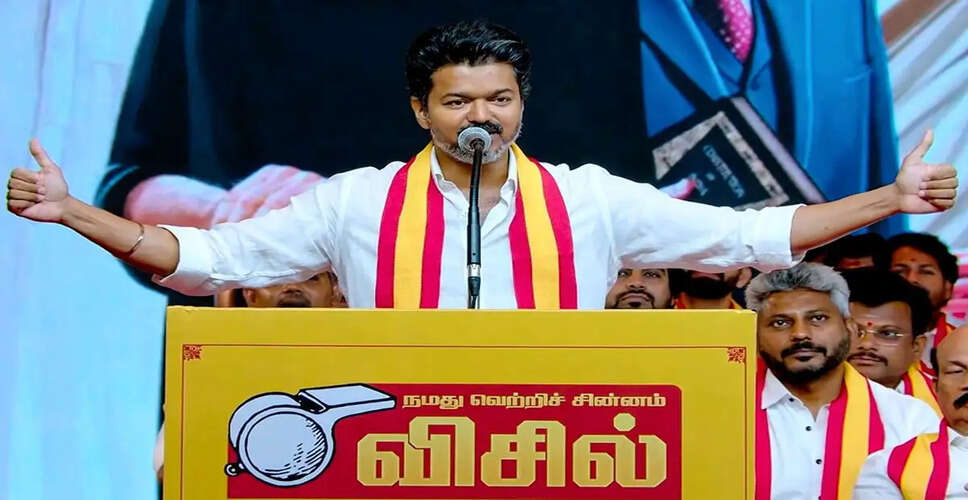

Vijay's Political Party Takes Major Steps Towards Government Formation
Actor-turned-politician Vijay's party, Tamilga Vetri Kadagam (TVK), has made significant strides in forming a government after emerging as the largest party in the recent assembly elections. Following a prolonged political deadlock and behind-the-scenes negotiations, TVK has finally secured the necessary support to achieve a majority. After confirming the coalition's strength, Vijay met with the Governor again this evening to inform him of their majority status.
The Communist Party of India, the Marxist Communist Party, and the VCK have decided to support Vijay's party. However, they have clarified that they will provide external support and will not be part of the cabinet led by Vijay. With this backing, TVK has crossed the majority threshold in the 234-member assembly. It is noteworthy that Vijay's party won 108 seats in the elections, but due to contesting from two seats, he will have to vacate one, leaving the effective count at 107. With the support of five Congress MLAs and a total of six from the left parties and VCK, the coalition's strength has reached 118.
Read More: Political Crisis in Tamil Nadu: Stalin Urges Governor to Expedite New Government Formation
Political insiders indicate that the Congress leadership played a crucial role in this development. Reports suggest that Congress leaders Rahul Gandhi and party president Mallikarjun Kharge personally negotiated with the left parties and VCK to secure their support for Vijay's party. Congress had already distanced itself from the DMK to align with Vijay. This shift increased pressure on smaller parties to join the coalition for government formation.
The left parties believe that holding fresh elections would disregard the public mandate. A left leader emphasized the importance of avoiding a situation that could lead to President's Rule in the state, asserting that the change the public voted for must be respected. VCK has also made it clear that it will not accept any external interference in Tamil Nadu's politics.
Another significant concern for these parties is the potential opportunistic alliance between the DMK and AIADMK. Political circles have been abuzz with speculation that if Vijay fails to form a government, these two rival parties might unite for power. However, the left parties argue that the public has already rejected both DMK and AIADMK, making any new coalition against the people's will unacceptable.
This morning, TVK legislators were engaged in continuous meetings. Party leaders expressed confidence that the parties they approached for support would remain steadfast until the end. Meanwhile, the left parties also finalized their support after state-level meetings, leading to VCK's announcement of backing.
This political development in Tamil Nadu is being viewed as historic. For decades, the state's politics revolved around DMK and AIADMK, but the rise of Vijay's party has shifted the entire political landscape. Analysts believe this is not just about forming a government but marks the beginning of a new era in the state's politics.
Simultaneously, the impact of this political shift is becoming evident at the national level. The DMK has written to Lok Sabha Speaker Om Birla, requesting changes in the seating arrangement for its MPs in Parliament. DMK MP Kanimozhi stated that the previous seating arrangement with Congress is no longer appropriate due to the changed political circumstances, as their alliance has ended.
This move by the DMK also signals significant implications for the future of the opposition alliance, INDIA. The breakdown of the decades-old alliance between Congress and DMK raises questions about opposition unity. Some opposition parties view Congress's decision as a strategic step to counter the BJP and NDA, while others label it as political betrayal. Samajwadi Party chief Akhilesh Yadav has also indirectly criticized Congress, suggesting that they are not among those who abandon their allies in tough times. This statement, coming ahead of the Uttar Pradesh assembly elections, is seen as indicative of shifting dynamics within the opposition alliance.
In summary, Vijay's government in Tamil Nadu has transcended mere state power change; it has sparked new debates regarding national politics, opposition coalitions, and future electoral strategies. It will be crucial to observe whether this new political equation remains confined to Tamil Nadu or influences the broader direction of national politics.