
Vice President Jagdeep Dhankhar Resigns Amid Political Controversy
Vice President Jagdeep Dhankhar's resignation on July 21, 2025, citing health reasons, has sparked speculation about underlying political tensions. Reports suggest that his acceptance of a proposal against Justice Yashwant Verma without government notification may have contributed to his departure. Union Health Minister JP Nadda's controversial remarks in Parliament further indicate growing rifts within the government. This situation raises critical questions about the Vice President's role and autonomy in the political landscape. As the implications of Dhankhar's resignation unfold, it highlights the delicate balance of power and the challenges faced by constitutional officers in India.
| Jul 23, 2025, 11:24 IST
Resignation Announcement
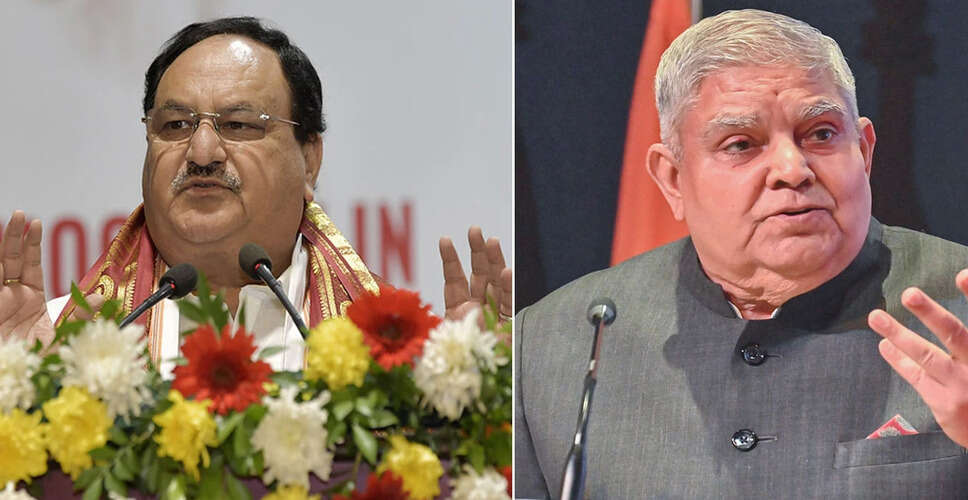
On July 21, 2025, Vice President Jagdeep Dhankhar announced his resignation, citing health issues, despite having two years remaining in his term. However, speculation has arisen in political circles suggesting that his resignation may be linked to allegations of 'border violations' or breaches of protocol. Reports indicate that a significant factor behind Dhankhar's departure was his acceptance of a proposal against Justice Yashwant Verma without informing the government, which reportedly angered the central authorities. Several ministers have indicated that Dhankhar has repeatedly overstepped his boundaries, making decisions beyond his jurisdiction. This raises the possibility that health concerns were merely a facade, with political disagreements and sharp differences being the true reasons for his exit.
Controversial Remarks in Parliament
Additionally, on the same day, Union Health Minister and BJP President JP Nadda made a startling remark amidst opposition uproar in the House, stating, “Nothing will go on record, only what I say will go on record.” This implies that only his statements would be officially noted, a comment more suited for informal settings than parliamentary discourse. This statement appeared to directly address the Rajya Sabha Chair, leading the opposition to label it as 'indignity to the Chair.' Nadda's comment suggests he was aware that Dhankhar was either asked to resign or would be soon. Following this, two meetings of the Business Advisory Committee (BAC), which determines the House's proceedings under the Vice President's chairmanship, were held, with Nadda and Parliamentary Affairs Minister Kiren Rijiju absent, indicating growing rifts between the government and the Vice President.
Political Disagreements and Their Implications
Moreover, recent events have highlighted that Dhankhar made parliamentary decisions that did not align with the government's political priorities. The occurrences before and after his resignation point towards a systematic political disagreement. This discord may stem not only from operational methods but also from a breakdown of trust and clashes with constitutional expectations. If a Vice President feels that their decisions are consistently being curtailed or that they are being signaled to refrain from exercising their discretion, resigning could be seen as a dignified choice.
Questions Raised by the Resignation
Furthermore, Dhankhar's resignation raises profound questions about the role of the Vice President. Are they merely a ceremonial figure, or should they have the autonomy to act based on their judgment? If a constitutional officer faces repeated interruptions in fulfilling their duties, it not only undermines the dignity of the position but also raises concerns about the fundamental nature of democracy. If a politician known for their clear opinions and bold stance feels pressured, resigning may indeed be the appropriate course of action.
Conclusion: A Broader Debate on Constitutional Roles
Ultimately, it has become evident that Jagdeep Dhankhar's resignation extends beyond mere health issues. This situation ignites a serious debate regarding authority within constitutional roles, and when statements like “what we say will be recorded” are made within Parliament, it not only disrespects the process but also strikes at the balance of power within the democratic framework. Dhankhar may have adhered to his constitutional limits, yet within those confines, he collided with the 'boundaries' that the political system had informally established.