
Vice President Jagdeep Dhankhar Resigns Amid Political Speculation
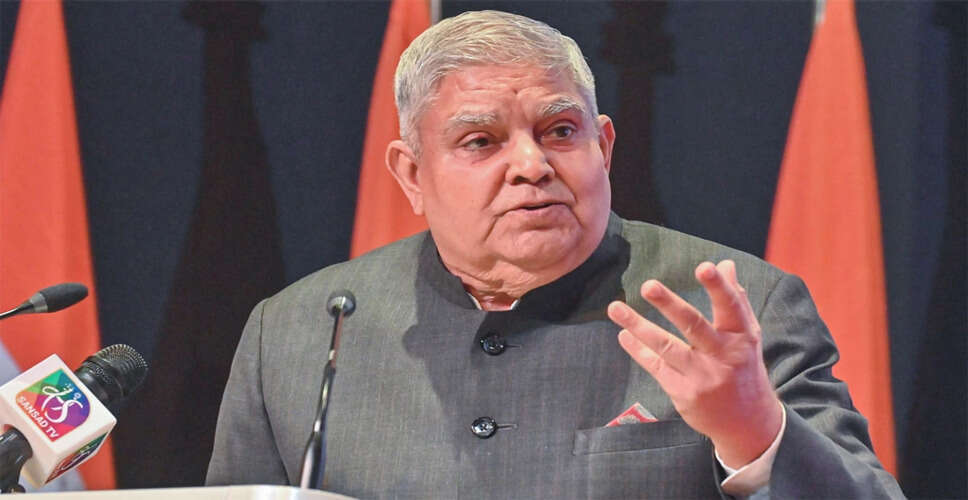
Unexpected Resignation of Vice President
On the inaugural day of the Rajya Sabha's monsoon session, Vice President Jagdeep Dhankhar was actively engaged in his duties, overseeing the proceedings and participating in the Business Advisory Committee meeting. His official visit to Jaipur was also announced. However, as the day progressed, an unexpected event unfolded that sent shockwaves through both Parliament and the broader political landscape. Dhankhar announced his resignation from the vice presidency with immediate effect, citing health issues and medical advice as reasons. This announcement has sparked rampant speculation regarding the underlying motives behind his decision.
Health Concerns or Political Discontent?
In his resignation letter, Dhankhar referenced Article 67(c) of the Constitution, stating that he was stepping down due to health reasons. He expressed gratitude towards President Droupadi Murmu and Prime Minister Narendra Modi. However, political analysts suggest that health may not be the sole factor behind this sudden move. Notably, Dhankhar underwent heart surgery at AIIMS in March and fainted during a speech in Nainital in June, which raised concerns about his health. Yet, he had appeared quite active in recent days, and his assertive presence in Parliament undermines the health-related narrative surrounding his resignation.
Political Implications of the Resignation
Dhankhar's resignation comes at a time when the monsoon session of Parliament has commenced, and the opposition is strategizing to challenge the government. This development is likely to create discomfort for the ruling party. There are discussions in political circles suggesting that Dhankhar had been feeling dissatisfied with his position. Signs of a rift between him and the ruling party emerged when he allowed opposition leader Mallikarjun Kharge to speak freely about the recent terrorist attack in Pahalgam, Jammu and Kashmir, and controversial statements made by former U.S. President Donald Trump regarding India.
Judicial Interests and Potential Pressures
Additionally, Dhankhar has shown a longstanding interest in judicial matters. His decision to accept a motion for impeachment against High Court judge Yashwant Verma was considered unusual. This raises questions about whether he faced pressure due to significant constitutional or institutional disagreements.
A Unique Resignation in Political History
Notably, Dhankhar is the first Vice President to resign without entering the race for the presidency. Previous Vice Presidents like V.V. Giri resigned to contest presidential elections, while others stepped down after assuming the presidency. His abrupt resignation, especially as someone who was appointed to significant roles like Governor of West Bengal and Vice President by the BJP, is viewed as a major political statement. Experts believe Dhankhar may now fully re-enter politics, potentially taking on a prominent role in Haryana or Rajasthan as a leading figure from the Jat community.
Future Political Landscape
Dhankhar's resignation should not be seen merely as a personal health issue but rather as a significant political indicator. It is likely to create discomfort for the ruling party, which the opposition may exploit to highlight perceived weaknesses or internal conflicts. If Dhankhar emerges in a new political role in the future, it would not come as a surprise.
Next Steps for the Vice Presidency
Looking ahead, it is essential to conduct elections for Dhankhar's successor 'as soon as possible.' According to Article 68(2) of the Constitution, elections must be held promptly to fill any vacancy caused by the Vice President's resignation, death, or removal. The elected individual will be entitled to hold office for a term of five years from the date of assuming office. The Constitution does not specify who will perform the Vice President's duties in the event of a resignation before the end of their term or while acting as President.
Eligibility Criteria for Vice President
The Vice President holds the second-highest constitutional position in the country, serving a five-year term. However, they may continue in office until their successor is appointed. The only provision in the Constitution regarding the Vice President's role as the Chairperson of the Rajya Sabha states that this role will be fulfilled by the Deputy Chairperson or another member authorized by the President during any vacancy. The resignation submitted by the Vice President takes effect from the day it is accepted. The Vice President is the ex-officio Chairperson of the Rajya Sabha and does not hold any other remunerative position. During any period when the Vice President acts as President, they do not perform the duties of the Chairperson of the Rajya Sabha and are not entitled to any salary or allowances due to the Chairperson. According to Article 66 of the Constitution, the election of the Vice President is conducted by an electoral college consisting of members from both Houses of Parliament through a single transferable vote system.
Who Can Be Elected as Vice President?
A person can only be elected as Vice President if they are a citizen of India, have attained the age of 35 years, and are eligible to be elected as a member of the Rajya Sabha. Individuals holding any office of profit under the Government of India, state governments, or any local authority are also disqualified from being elected.