
US Stock Market Faces Turmoil Amid Escalating Trade War with China
Market Reaction to Trade Tensions
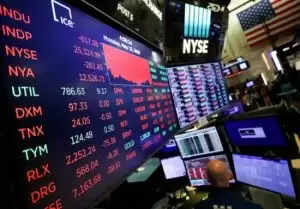
New York: The US stock market experienced significant declines on Friday as American companies faced renewed pressure following China's decision to match President Donald Trump's tariffs, intensifying the ongoing trade conflict.
On this day, nearly all sectors were affected, following a staggering loss of $2 trillion in market value the previous day, marking the largest single-day drop since the onset of the COVID-19 pandemic five years ago.
In response to the US imposing a 34% tariff on Chinese imports, China's Commerce Ministry announced it would retaliate with a similar tariff on all US goods starting April 10.
Industries reliant on exports to China, such as aerospace, agriculture, and heavy machinery, were particularly hard hit on Friday.
Many of the major losers from Thursday, including banks, airlines, and tech firms, continued to decline, although some sectors like retail and restaurants fared slightly better, with companies like Nike even seeing minor gains.
Tariffs act as a tax on businesses, which can lead to increased prices for consumers. If costs rise, consumers may reduce spending on non-essential items, which could significantly impact the economy.
Consumer spending constitutes about 70% of the US economy, and a drop in demand could lead to reduced production and potential recession.
JPMorgan has raised its recession risk forecast to 60%, up from 40% previously.
During morning trading, the three major US stock indexes fell between 3.5% and 4.5%.
Here’s a closer look at some of the sectors and companies that performed poorly on Friday.
Agriculture and Heavy Equipment
The US exports significant amounts of heavy machinery and agricultural products to China.
Deere & Co saw a 2.8% drop on Friday after a 5% decline the previous day.
Archer-Daniels-Midland fell by 7.1% on Friday, following a 0.8% loss on Thursday.
Caterpillar experienced a 5.2% decrease on Friday after an 8.6% drop the day before.
Aerospace and Defense
Aerospace firms also heavily depend on exports to China. In retaliation, China has imposed stricter export controls on rare earth materials, crucial for high-tech and defense manufacturing.
Boeing's stock fell by 8% on Friday after a 10.5% loss on Thursday.
General Dynamics dropped 3.4% on Friday, following a 2.3% decline the previous day.
Airlines
Airlines had anticipated a profitable year, but rising prices for essentials could hinder consumer travel budgets.
United Airlines saw a 10.4% drop on Friday after a 15.6% decline on Thursday.
American Airlines fell by 8.3% on Friday, following a 10.3% loss the previous day.
Delta Air Lines dropped 7.3% on Friday after losing 10.7% on Thursday.
Technology
Tech companies that manufacture computers and smartphones often source parts from abroad, meaning they will incur tariffs on imported products.
Apple's stock decreased by 3.2% on Friday after a 9.3% drop on Thursday.
HP fell by 4.3% on Friday, following a 14.7% loss the previous day.
Dell's stock dropped 4.9% on Friday after a 19% decline on Thursday.
Nvidia saw a 5.3% decrease on Friday after losing 7.8% on Thursday.
Banks
In the event of a recession, both households and businesses are likely to borrow less, leading to decreased demand for products and services.
Wells Fargo's stock fell by 6% on Friday after a 9.1% drop on Thursday.
Bank of America decreased by 6.7% on Friday, following an 11.1% loss the previous day.
JPMorgan Chase saw a 6.2% decline on Friday after a 7% drop on Thursday.
Automakers
Interestingly, automakers were not as severely impacted as other sectors on Thursday, possibly due to sourcing steel and aluminum domestically, which mitigates the impact of tariffs.
General Motors fell by 3.2% on Friday after a 4.3% decline on Thursday.
Ford's stock increased by 0.5% on Friday after a 6% drop the previous day.
Tesla's stock decreased by 7.7% on Friday after a 5.5% loss on Thursday.