
U.S. Secretary of State Marco Rubio's Visit to India: Strengthening Bilateral Ties
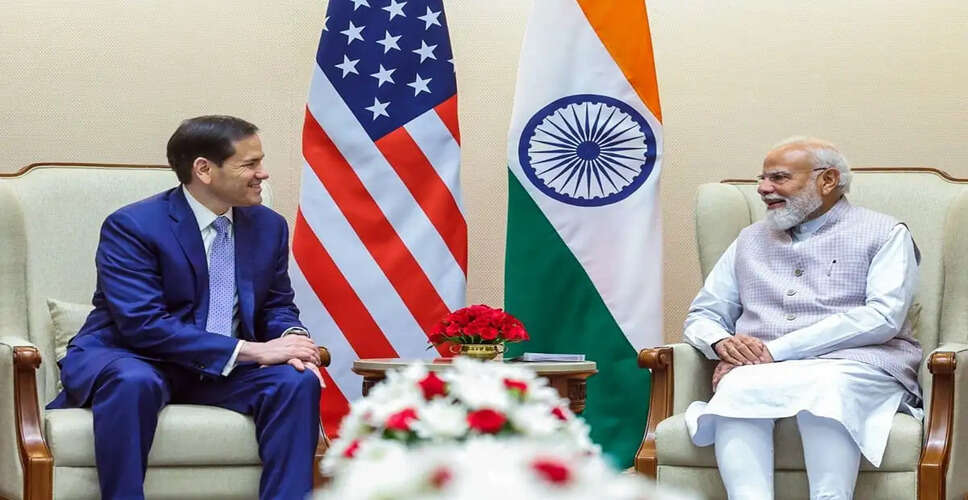

Significant Discussions Between Rubio and Modi
Amid rising tensions regarding a potential U.S. conflict with Iran, Secretary of State Marco Rubio met with Prime Minister Narendra Modi today to discuss various critical regional and global issues. During his four-day visit to India, Rubio informed Modi about the ongoing advancements in U.S.-India cooperation in key areas such as defense, strategic technology, trade and investment, energy security, connectivity, education, and public diplomacy. He also shared the U.S. perspective on several global matters, including those concerning West Asia. Modi reiterated India's commitment to peace efforts, emphasizing that all conflicts should be resolved through dialogue and diplomacy. Additionally, he requested Rubio to convey his best wishes to U.S. President Donald Trump. Rubio extended an invitation for Modi to visit the White House.
A New Phase in U.S.-India Strategic Partnership
The meeting between Modi and Rubio is viewed as a new chapter in the U.S.-India strategic partnership amidst a shifting global power balance. The discussions focused on defense, trade, energy, critical technologies, and security in the Indo-Pacific region. U.S. Ambassador to India, Sergio Gore, noted that meaningful conversations took place regarding deepening cooperation in security, trade, and critical technologies, highlighting India's significance as a crucial partner for the U.S. Both nations are working together to promote a free and open Indo-Pacific region.
Timely Visit Amid Global Tensions
Rubio's visit comes at a time when China's increasing assertiveness, strategic competition in the Indo-Pacific, and rising tensions in West Asia are reshaping global politics. In this context, the growing closeness between India and the U.S. is considered vital. There is a rapid expansion of defense cooperation, maritime security, and emerging technologies between the two countries, which could significantly impact the power balance in the Asia-Pacific region.
Energy Cooperation and Strategic Security
Before arriving in India, Rubio indicated that the U.S. aims to broaden energy cooperation with India, stating that the U.S. is prepared to supply as much energy as India wishes to purchase. This statement comes amid rising concerns over energy security due to tensions in the Persian Gulf and uncertainties surrounding the Strait of Hormuz. As one of the world's largest energy importers, India is directly affected by any instability in West Asia, making energy collaboration with the U.S. a strategic security asset.
Quad and Regional Stability
Rubio described India as a great partner and reliable ally, noting that significant work is being done in various important sectors. He also mentioned his intention to participate in the Quad foreign ministers' meeting during his visit. The Quad, comprising India, the U.S., Japan, and Australia, aims to enhance stability, maritime security, and a rules-based order in the Indo-Pacific region.
Cultural Engagement and Humanitarian Efforts
Rubio began his visit in Kolkata, where he toured the headquarters of the Missionaries of Charity founded by Mother Teresa. He also visited the Nirmala Shishu Bhavan and the Victoria Memorial. This part of the trip is seen as a step towards conveying humanitarian and cultural messages. Accompanied by his wife Janet Rubio and Ambassador Gore, he emphasized that U.S.-India relations extend beyond strategic interests, rooted in shared values and a spirit of selfless service.
Strategic Implications of the Visit
A significant strategic aspect of Rubio's visit relates to West Asia and Iran. Prior to the trip, he criticized NATO countries, asserting that Iran poses a threat to global security and should not acquire nuclear weapons. This statement indicates the U.S.'s efforts to strengthen its strategic position in West Asia, making India's partnership crucial. Conversely, India has maintained a balanced stance, advocating for peaceful resolutions and diplomatic dialogue in all disputes.
Conclusion: A New Chapter in U.S.-India Relations
Overall, Marco Rubio's visit signals a new chapter in U.S.-India relations. The growing collaboration in defense, energy, trade, technology, and Indo-Pacific security is set to not only strengthen the interests of both nations but also have a profound impact on the global strategic balance. This visit underscores that in the changing international landscape, India and the U.S. view each other as long-term and reliable strategic partners.