
US Prepares for Major Strikes Against Iran Amid Ongoing Conflict
Intensifying Military Actions
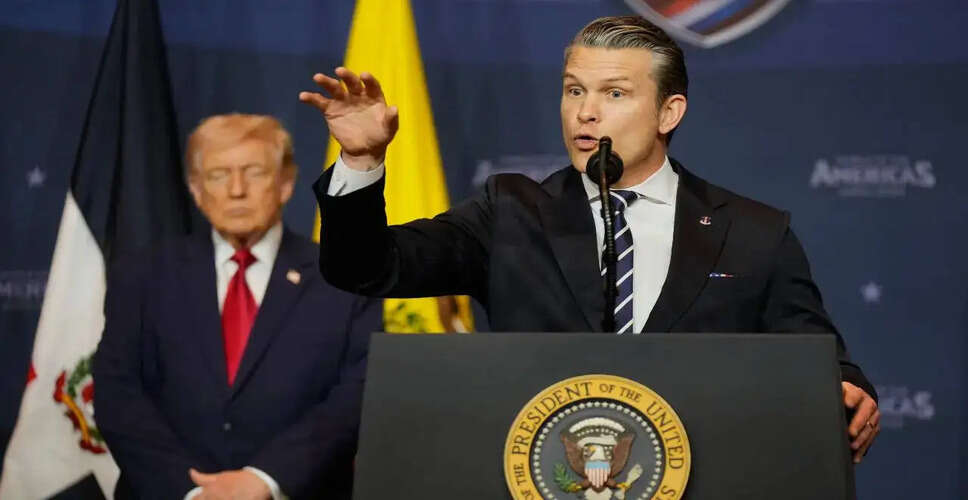
On Friday, Pete Hegseth announced that the United States is gearing up for its most extensive series of strikes against Iran since the onset of the conflict. He highlighted that the pace and strategy of these military actions would ultimately be dictated by President Donald Trump. During a press briefing, Hegseth stated, "Today marks the highest volume of US strikes on Iran to date." He emphasized that Trump is in control of the situation, determining the tempo and timing of the military engagement.
The remarks came as hostilities escalated between the United States, Israel, and Iran following the war's outbreak on February 28. Hegseth also mentioned that Iran's new supreme leader, Mojtaba Khamenei, has sustained injuries during the ongoing conflict. "We are aware that the so-called supreme leader is wounded and likely disfigured," he remarked. Khamenei took over leadership after the death of his father, Ali Khamenei, in a bombing at the war's commencement.
According to Hegseth, the US and Israel have executed a significant air campaign against Iran, targeting over 15,000 locations since the conflict began. He described the strikes as having severely diminished Iran's military strength, noting that the intensity of the attacks is unprecedented against a contemporary military force. "The United States is dismantling the radical Iranian regime's military capabilities in a manner never witnessed before," he stated, asserting that Iran's armed forces have been rapidly weakened and rendered largely ineffective.
Hegseth reiterated that the US had previously warned that the conflict would not be a fair fight. He noted, "We indicated that it would not be an even match, and it has proven to be so." He explained that the combined air power of the US and Israel has allowed for a striking frequency rarely observed in modern warfare, with an average of over 1,000 strikes daily.
American fighter jets and bombers continue to operate across Iran, including missions over Tehran. Hegseth stated, "Our aircraft are actively flying over Iran and Tehran, selecting targets as intelligence improves." He also pointed out that Iranian leadership is increasingly retreating underground as military pressure escalates, with leaders hiding in bunkers and civilian areas. "The only thing expanding is our advantage," he added.
Furthermore, Hegseth noted that Gulf partners have enhanced their collaboration with the US through integrated air defense systems and are now more involved in offensive operations alongside defensive efforts. He concluded, "Our resolve is unwavering, our options are maximized, and our capabilities continue to grow. We're advancing, while they are retreating." He reaffirmed that the direction of the conflict ultimately lies with President Trump, who will determine the future of the military campaign. Hegseth also emphasized the US commitment to maintaining the Strait of Hormuz as a vital shipping lane for global trade, ensuring the uninterrupted flow of energy and commercial goods through this crucial waterway.