
US Maintains Naval Blockade Despite Iran's Reopening of Strait of Hormuz
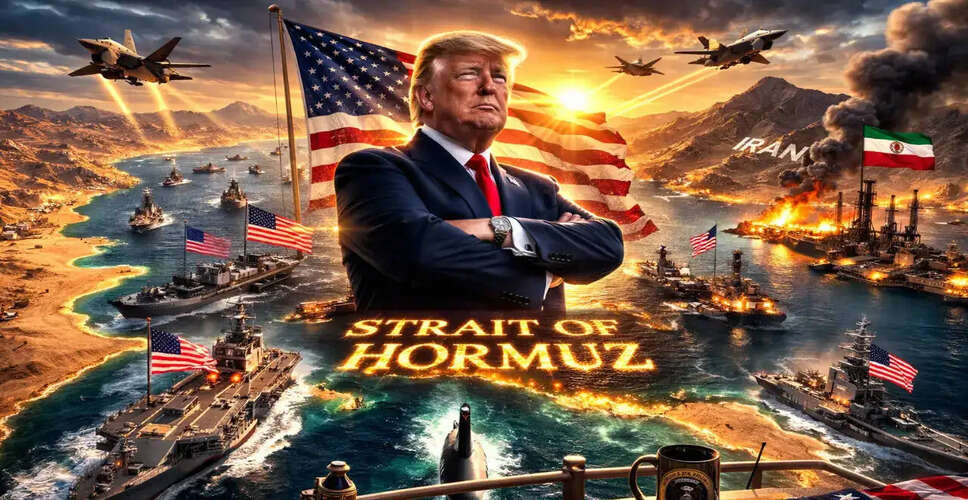

US President's Stance on the Strait of Hormuz
Washington DC: Following Iran's announcement to reopen the Strait of Hormuz for all vessels, President Donald Trump declared that the naval blockade enforced by US forces in this vital waterway will continue to be in "full force" and "effect." Trump emphasized that the blockade will remain until the agreement with Iran is "100 percent complete." In a post on Truth Social, he stated, "The Strait of Hormuz is completely open and ready for business and full passage, but the naval blockade will remain in full force and effect as it pertains to Iran, only, until such time as our transaction with Iran is 100% complete." He also noted that many of the points raised by the US have already been negotiated. In his initial response to Iran's announcement, Trump referred to the waterway as the "Strait of Hormuz."
"Iran has just announced that the Strait of Iran is fully open and ready for full passage. "Thank you!" the President added in his Truth Social update. The US has implemented a naval blockade in the Strait of Hormuz, deploying at least 15 warships, including the amphibious assault ship USS Tripoli (LHA 7), which is currently operating F-35B Lightning II stealth fighters and MV-22 Ospreys in the Arabian Sea. The US Central Command confirmed that the blockade commenced at 1400 GMT on Monday.Iran's Announcement on the Strait of Hormuz: Earlier, Iran declared that commercial shipping through the Strait of Hormuz would remain “completely open” during the ongoing ceasefire, aiming to reassure global trade and energy markets after weeks of disruptions. Iran's Foreign Minister Sayed Abbas Araghchi made this announcement. "In line with the ceasefire in Lebanon, the passage for all commercial vessels through the Strait of Hormuz is declared completely open for the remaining period of ceasefire, on the coordinated route as already announced by Ports and Maritime Organisation of the Islamic Rep. of Iran," Araghchi stated on X.
The Strait of Hormuz is a crucial shipping route, responsible for approximately one-fifth of global oil and energy supplies. Any disruption in this narrow passage can lead to immediate global economic repercussions, impacting oil prices, shipping routes, and supply chains. Notably, 20 percent of the world's crude oil and liquefied natural gas transit through this essential waterway. The strait was previously blockaded by Iran's Islamic Revolutionary Guard Corps (IRGC) following US and Israeli airstrikes on Tehran on February 28, which triggered an energy crisis in the region.araghchi
2045121573124759713